AI Workflow Automation
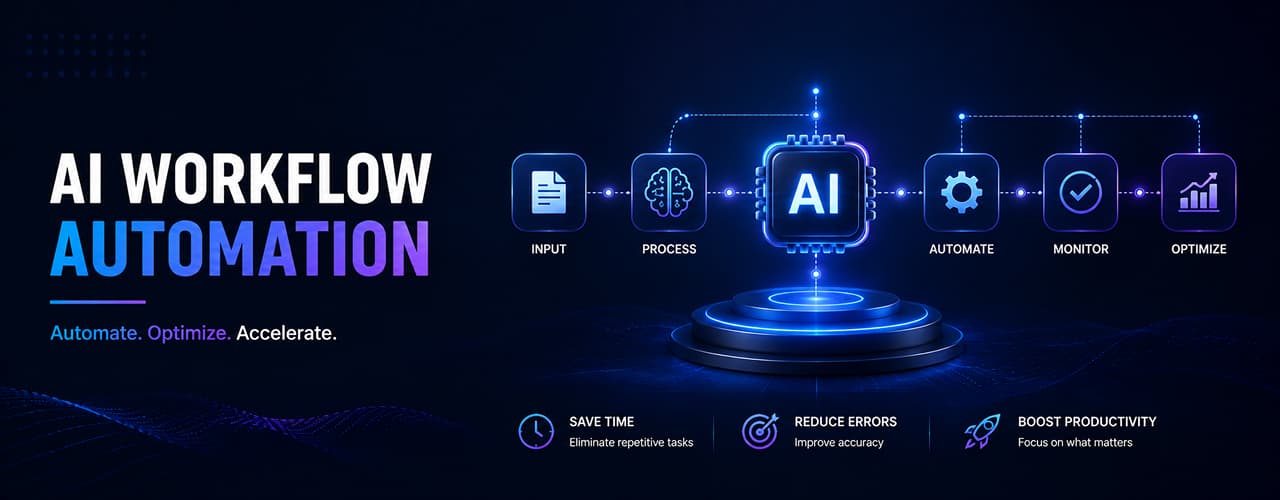
AI Workflow Automation: Guide to Smarter Business Processes
Businesses today are under constant pressure to improve efficiency, reduce operational costs, and deliver faster services without lowering the quality of performance. Usually, conventional workflows include repetitive manual procedures which take much time and increase the risks of mistakes. This problem can be solved by AI Workflow Automation.In this guide, you'll learn what is AI workflow automation, how it works, business benefits, popular automation tools, how to implement AI workflow and best practices.
What is AI Workflow Automation?
AI Workflow Automation is the process of using artificial intelligence technologies— such as machine learning, natural language processing (NLP), computer vision, and predictive analytics in order to automate business processes that usually need human intervention.
Unlike rule-based automation, AI-powered systems are able to understand the context, analyze large amounts of data, detect patterns, and make decisions based on data analysis.
The goal is not to replace employees, but to automate repetitive tasks and give employees more time to innovate, maintain customer relations, and grow the business.
How AI Workflow Automation Works
A typical AI-powered workflow follows these stages:
1. Data Collection
Information is gathered from multiple business systems such as CRM systems, ERP systems, emails, forms, customer databases, or cloud-based applications.
2. AI Analysis
The AI system processes the input information through machine learning techniques, language understanding, or predictive models.
3. Decision Making
Instead of waiting days or weeks, customers can receive claim decisions much faster.
4. Workflow Execution
Tasks are assigned, notifications sent, approval made, updates recorded, and reports compiled without the need for any manual intervention.
5. Continuous Learning
Unlike traditional automation, AI becomes better over time through learning from its previous experiences and user interactions.
Benefits of AI Workflow Automation
Implementation of AI Workflow Automation provides definite business benefits in all kinds of industries.
Increased Productivity
Employees spend less time on repetitive administrative work and more time on resolving complex business issues.
Faster Decision-Making
AI analyses large datasets within seconds, enabling businesses to react to changing operations.
Reduced Human Errors
Automation minimises manual mistakes in data entry, document processing, approvals, and reporting.
Lower Operational Costs
Businesses reduce labour-intensive processes and better use their resources.
Better Customer Experience
AI-powered workflows provide quick responses, personalized experiences, and consistency in quality of service.
Improved Compliance
Automated workflows ensure business processes follow company policies and legal regulations while keeping a perfect audit trail.
These advantages make AI Workflow Automation an essential component of modern digital transformation strategies.
Popular AI Workflow Automation Tools
Choosing the right AI workflow automation tools depends on your business size, existing technology stack, and automation goals.
When evaluating AI workflow automation tools, consider factors such as scalability, security, ease of integration, analytics capabilities, AI features, and vendor support.
Some widely used solutions include:
- Microsoft Power Automate
- UiPath
- Automation Anywhere
- Zapier AI
- Workato
- Make (formerly Integromat)
- ServiceNow AI
- IBM Watson Orchestrate
- Google Vertex AI
- Salesforce Flow
Best Practices for Workflow Automation
Following the best practices helps organisations achieve long-term success.
These practices ensure automation remains accurate, scalable, secure, and aligned with evolving business objectives.
Some important recommendations include:
- Standardize business processes before automating them.
- Simplify workflows in the first phase of implementation.
- Constantly evaluate the performance of workflows.
- Train AI models constantly using new data.
- Have good security and control measures.
- Involve employees in the process of implementation.
- Evaluate the results of automation and optimize workflows regularly.
FAQs
1. What is AI workflow automation?
AI workflow automation is an application of artificial intelligence that automates business processes through repetition, improves efficiency, and reduces manual work.
2. How does AI workflow automation work?
It collects data, analyzes it with the help of AI, takes decisions, and performs tasks as per set workflows.
3. What are the benefits of AI workflow automation?
It saves time, reduces errors, lowers costs, increased efficiency, and faster decision making for businesses.
4. What are the best AI workflow automation tools?
Popular tools include Microsoft Power Automate, UiPath, Automation Anywhere, Workato, Zapier AI, and Make.
5. Is AI workflow automation secure?
Yes, when AI workflow automation is done with all appropriate safety measures such as encryption and access rights.
