Web Application Development
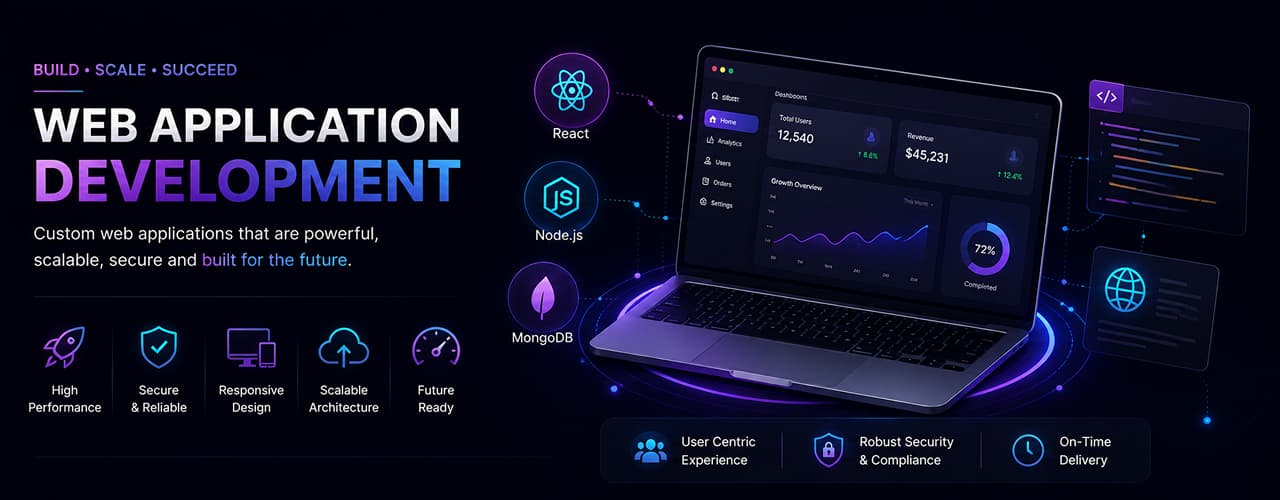
Web Application Development: Comprehensive Guide for Business
Web applications help businesses deliver interactive, scalable, and accessible digital experiences directly through a browser. From customer portals and eCommerce platforms to enterprise dashboards, Web application development allows companies to develop solutions based on specific business needs. This guide will cover how web apps function, types of web apps, their advantages, technologies involved, cost of development, and more.
What is Web Application Development?
Web application development is the process of planning, designing, building, testing, and maintaining software that users access through a web browser. Unlike a basic website, a web application allows the user to work with data, accounts, processes, dashboards, payments, or any business function.
Custom web application development is done by businesses where they cannot find ready-made software that would suit them in terms of workflows, integration, security and user experience.
How Does Web Application Development Work?
The process starts with understanding the business objective and identifying the users, features, and scope of the project. Next, developers outline the user experience, application architecture, technology stack, database schema, and integrations.
In web application development, the frontend is responsible for user interface while the backend takes care of business logic, data, authentication, and other server-side actions. Next, testing will be done to find out functional, performance, usability, and security problems prior to launch. Once the software is launched, it will be monitored, maintained, updated and improved.
For businesses researching how to develop web application solutions, the key is to begin with a clear problem rather than selecting technologies first. This will determine the best way to create an application that is scalable, usable, secure, and effective.
What are the Different Types of Web Applications?
The right choice is the one that depends not only on popularity but on the audience, features, data, traffic and future prospects too.
Different business goals require different application models. Common types include:
- Single-page applications (SPAs): These update content dynamically without repeatedly loading complete pages, making them suitable for interactive dashboards and online tools.
- Multi-page applications (MPAs): These use multiple pages and can work well for content-heavy platforms, eCommerce systems, and large business websites.
- Progressive web applications (PWAs): These combine web accessibility with app-like capabilities such as offline support, fast loading, and notifications.
- Enterprise web applications: These support internal workflows such as HR, finance, operations, reporting, customer management, and collaboration.
What are the Benefits of Web Application Development?
These advantages could make web application development a reasonable choice for any enterprise that looks for an effective digital solution.
A strong web application can provide some benefits to businesses and users alike. Key benefits include:
- Accessibility: Users can access browser-based applications across supported devices without installing traditional software.
- Scalability: A well-designed architecture can grow with users, transactions, features, and data.
- Centralized updates: Improvements can be deployed from the application environment, reducing the need for users to install separate versions.
- Integration: Applications can connect with CRMs, payment systems, analytics tools, APIs, and internal software.
- Better user experiences: Purpose-built workflows can reduce unnecessary steps and make business processes easier to complete.Knowledge management
- Operational efficiency: Automation and centralized data can reduce repetitive manual work and improve visibility.
What Technologies are Used for Web Application Development?
Technology stack is dependent on the functionality, scale, security needs, and skills of the development team. Front-end technologies are usually based on HTML, CSS, JavaScript, and libraries, such as React, Angular, or Vue.
Database technologies may be PostgreSQL, MySQL, MongoDB, and any other technology chosen based on the data model used by the application. Cloud-based technologies may be Amazon Web Services, Microsoft Azure, or Google Cloud.
Modern teams may also use APIs, containers, CI/CD pipeline, automated testing, analytics, and AI-based tools. However, the main idea is not to select the most trendy stack, but a secure and scalable stack.
How Much Does Web Application Development Cost?
There is no universal price for a web application. The final cost will depend on things like complexity of an application, features, UI/UX design, integrations, tech stack, security, testing, development team, and maintenance.
A basic system with minimal features will take relatively less time and effort than a more complicated and costly system that involves many different features.
An effective approach to determining the cost would be setting up the list of features that should be included initially, followed by subsequent phases of development. This will allow business owners to have greater budget clarity without affecting the future of their product.
Why Choose Centrelocus?
Centrelocus helps businesses build secure, scalable, and user-focused digital solutions aligned with their business goals. We assist businesses in software development, AI, digital transformation, and other emerging technologies from concept to deployment.
With web application development services, the Centrelocus concentrates on providing practical solutions, modern technology, and scalability.
FAQs
1. What is web application development?
Web application development is the development of software programs that people can use using a web browser for accomplishing particular tasks or services.
2. What is the difference between a website and a web application?
A website gives information to the user, whereas a web application makes it possible for the user to interact with the program.
3. What are the different types of web applications?
Examples of web applications are single page applications, multi-page applications, progressive web applications, e-commerce applications and enterprise web applications.
4. Is web application development suitable for small businesses?
Yes. Small businesses can use web apps to automate operations, handle customers, and provide efficient digital solutions
5. Can web applications work on mobile devices?
Yes. A responsive web application can operate on smartphones, tablets, laptops, and desktops because of its ability to adapt to various screen sizes.
6. Is web application development suitable for startups?
Yes. Startups may utilize web applications in order to market their products and services online.
