
Web App vs Mobile App
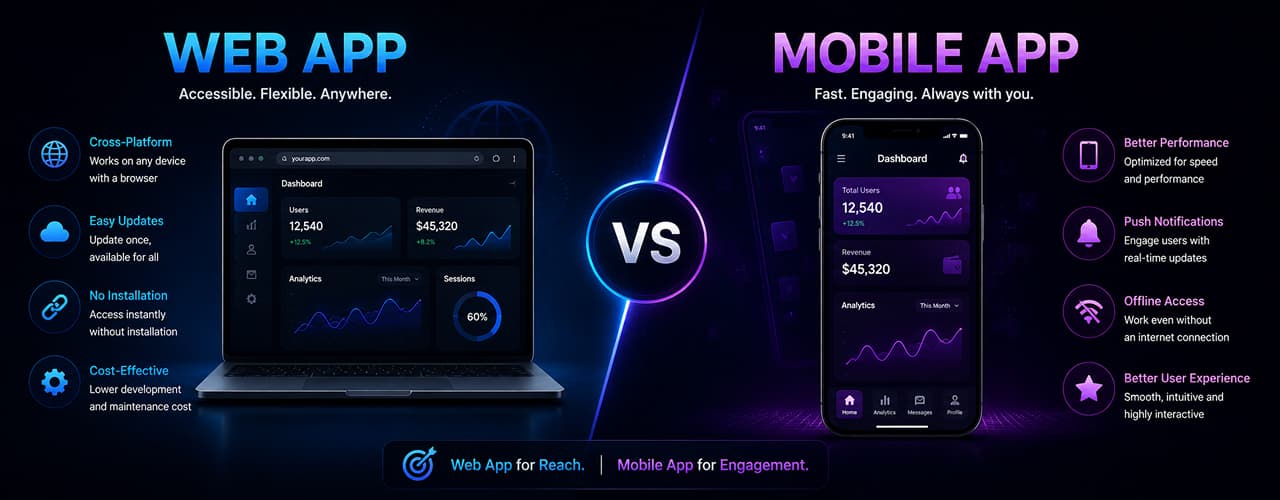
Web App vs Mobile App: Which One Is Right for Your Business?
Choosing between web app vs mobile app is one of the most important decisions when planning a digital product. Making this choice depends on the specific needs of an organization in terms of its aims, target customers, budget, etc. Despite some common functions, both vary significantly in terms of their development process, ease of access, maintenance, and performance. Understanding these differences helps organizations invest in the right technology and create better digital experiences.
What is a Web App?
A web app is an interactive application that operates through the browser without any need for users to download and install the software via an app store. Built using technologies such as HTML, CSS, JavaScript, and modern frameworks, web apps are accessible from desktops, tablets, and smartphones with an internet connection.
Businesses often choose web applications because they are easier to deploy, update, and maintain. Since each user will use the most updated version of the software through their browser, no download is needed.
What is a Mobile App?
A mobile app is software specifically developed for smartphones and tablets. It can be installed using the application store such as Google Play Store or Apple App Store. Native apps are either for Android or iOS and therefore integrate well with the functionalities of the mobile devices such as GPS, cameras, biometrics, Bluetooth, and push notifications.
Mobile apps provide faster performance, richer user experiences, and offline functionality. They are commonly used for banking, healthcare, eCommerce, gaming, ride-sharing, and food delivery applications where speed and engagement are essential.
Web App vs Mobile App: Key Differences
Understanding the difference requires evaluating several technical and business factors
When evaluating the difference between web app and mobile app, businesses must analyze the future potential of scalability, user expectations, security, maintenance, and necessary features.
- Accessibility: Web apps are available through browsers on virtually any device, while mobile apps require installation before use.
- Performance: Mobile apps typically deliver smoother navigation and faster response times because they run directly on the device. Web apps rely more on browser capabilities and internet connectivity.
- Development: A single web application can support multiple platforms using one codebase, whereas mobile apps may require separate Android and iOS development unless cross-platform technologies are adopted.
- Maintenance: Web apps updates are deployed instantly. Mobile applications require publishing updates through app stores, and users may need to download them.
Pros and Cons of Web Apps
Web applications offer numerous advantages for businesses that need quick implementation and easy access.
Users can access them from almost any browser without installation. They cost less to develop and maintain since the application is used by many devices. Businesses also benefit from simplified updates and easier content management.
However, web apps have limitations. They generally require an internet connection, have restricted offline functionality, and cannot always access advanced device hardware. When comparing web apps vs mobile apps, browser-based applications shine in their accessibility.
Pros and Cons of Mobile Apps
Mobile applications are designed to be very optimized for use on smartphones and tablets.
Their greatest strength is performance. Being installed directly into the device, they guarantee quick load times, better interactions and increased integration with hardware such as cameras, GPS, and biometric authentication.
Offline access is another significant advantage, allowing users to continue working even when connectivity is limited.
Some disadvantages of mobile apps include their higher cost of creation and maintenance, as well as the need for app store approval. During the debate of mobile app vs web app, businesses tend to opt for mobile apps if engagement is their goal.
When Should You Choose a Web App?
A web app is the right choice when your priority is reaching the widest possible audience with minimal friction. Organizations launching SaaS products, educational portals, internal management systems, reservation platforms, or customer dashboards often benefit from browser accessibility.
Should quick deployment, easy maintenance, and better SEO be on the agenda, then web app vs mobile app considerations will usually lean towards web apps.
When Should You Choose a Mobile App?
A mobile application is better suited for businesses that need personalization and more features available on devices.
Industries such as healthcare, fintech, logistics, fitness, gaming, and on-demand services frequently require push notifications, offline access, camera integration, GPS tracking, and biometric authentication.
When deciding between web app vs mobile app, businesses must consider how users use their services and how native features can give them an edge over competitors.
Can You Build Both a Web App and a Mobile App?
Yes. Many successful companies build both platforms to maximize customer reach while delivering consistent user experiences.
A common strategy is to launch a web application first to validate the business idea and then expand into mobile development as customer demand increases. Businesses deciding on web app or mobile app don't always have to choose only one. With modern APIs and scalable architectures, both platforms can work together seamlessly while sharing data, branding, and functionality.
Conclusion
Choosing web app vs mobile app is not about finding a universally better option but selecting the solution that aligns with your business objectives, audience, and growth strategy. Web applications offer accessibility, faster deployment, and easier maintenance, while mobile applications provide exceptional performance, offline capabilities, and deeper device integration. Partnering with an experienced development company like Centrelocus ensures your digital solution is secure, scalable, and designed for sustainable success.
FAQs
1. Which is better, a mobile app or a web app?
It depends on your goals. Web apps offer wider accessibility and lower cost, but mobile apps can work faster and do not need any Internet connection.
2. Is a web app the same as a mobile app?
No. A web app runs in a browser without installation, whereas a mobile app is installed on a smartphone or tablet through an app store.
3. Is a web app cheaper to develop than a mobile app?
Generally, yes. Web apps usually cost less as a single code base will be sufficient for all platforms.
4. Can a web app work offline?
Most web apps require an internet connection. But Progressive Web Applications (PWAs) have some offline capabilities too.
5. Should I build a web app or a mobile app first?
If you want faster deployment and wider reach, start with a web app. Choose a mobile app first if your product depends on device features, offline access, or frequent user engagement.
