SaaS Application Development
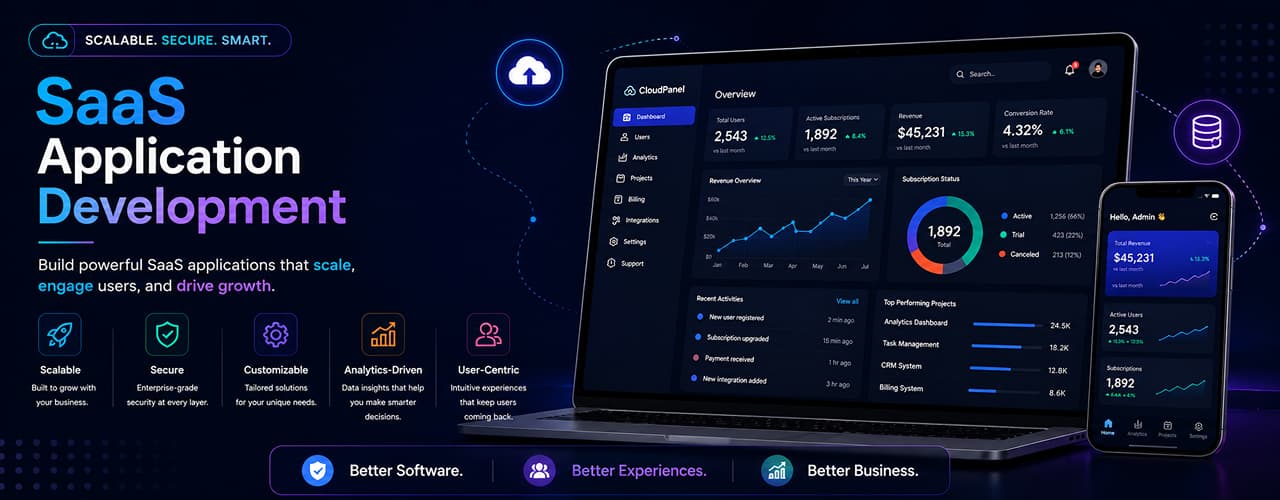
SaaS Application Development: Build Scalable Cloud-Based Solutions
SaaS application development focuses on building scalable, secure, and cloud-based software that users can access anytime through the internet. It enables businesses to deliver software without requiring users to install or maintain it locally. From subscription-based business tools to industry-specific platforms, SaaS applications help organizations streamline operations, improve accessibility, and scale efficiently.
What is SaaS Application Development?
SaaS Application Development is the process of designing, building, testing, deploying, and maintaining software that customers access over the internet, usually through a browser or mobile device. Rather than having the software installed onto separate machines, users gain access to centrally hosted software that doesn’t require installation for updates.
What does SaaS Product Development Mean?
SaaS Product Development involves developing an idea for a business into a workable cloud-based product. It covers product discovery, user research, UX planning, architecture, development, testing, deployment, analytics, and continuous improvement.
How does SaaS Application Development Work?
A practical SaaS product development process usually moves through these stages:
- Discovery and validation: Define the audience, business problem, core use cases, competitive landscape, and goals.
- Product planning: Prioritize MVP features, map user journeys, define requirements, and establish measurable outcomes.
- UX and architecture: Design the interface and select an architecture that supports security, integrations, availability, and growth.
- Development: Build the frontend, backend, APIs, database, authentication, and required components.
- Testing and deployment: Validate functionality, security, performance, and user experience before configuring production infrastructure.
What are the Types of SaaS Products?
SaaS products can serve almost any industry or business function. Common categories include:
- CRM platforms for leads, accounts, sales pipelines, and customer interactions.
- ERP systems for finance, operations, inventory, procurement, and business workflows.
- Project and task management tools for collaboration, scheduling, reporting, and productivity.
- Marketing automation platforms for campaigns, lead nurturing, analytics, and engagement.
- HR and payroll platforms for employee management, recruitment, attendance, and workforce operations.
- Communication and collaboration platforms for messaging, meetings, file sharing, and distributed teams.
- Vertical SaaS products designed for sectors such as healthcare, education, logistics, finance, or real estate.
What are the Benefits of SaaS Product Development?
A well-planned strategy also considers the product lifecycle beyond the first release. There is a need for teams to come up with success criteria including activation, retention, conversion, volume of support requests, and cost of infrastructure.
SaaS Product Development can offer several strategic advantages:
- Recurring revenue: Subscription pricing can create a predictable revenue model.
- Faster distribution: Customers access the product online without traditional installation.
- Centralized updates: Features, fixes, and security improvements can be released centrally.
- Scalability: Cloud infrastructure can support growth in users, traffic, and data.
- Accessibility: Customers can use the product across supported devices and locations.
What Features Should a SaaS Application Have?
Almost all platforms can use secure user registration and sign-in, roles, dashboards, search, notifications, billing and payment, subscriptions, reporting, APIs, integrations, and administrative features.
Security needs to be inherent in the design of the system. This includes encryption, secure authentication, authorization, auditing, backups, monitoring, and proper data handling.
For products serving many organizations, multi-tenancy is especially important. The platform should separate customer data while allowing efficient administration and controlled resource sharing.
Another important consideration in SaaS Application Development is onboarding. Good onboarding flows, guidance, role setting, and account management make the onboarding easier for the customers.
Why Choose SaaS Application Development for Your Business?
SaaS Application Development can be a strong option when a business wants to turn repeatable workflows, specialized expertise, or a scalable service into a digital product. It can help organizations launch an MVP, validate demand, gather feedback, and evolve the product without rebuilding the platform for every client.
For complex products, SaaS Product development from scratch should include business validation alongside technical planning. This reduces the risk of building unnecessary features and creates a clearer path toward product-market fit.
Finally, SaaS Application Development works best when product, design, engineering, and business stakeholders share the same roadmap. Regular feedback keeps the solution aligned with real customer needs and commercial goals.
How to Develop a SaaS Product From Scratch?
A successful SaaS Application Development journey starts with a specific problem rather than a long feature list. Validate the idea, define the ideal customer, identify the MVP, map the user journey, choose the architecture, build the core experience, test with users, and measure results after launch.
For organizations comparing SaaS Development Services, the right partner should explain technical trade-offs in business terms and provide a realistic roadmap rather than promising instant results.
A roadmap is:
Why choose Centrelocus?
Centrelocus approaches software projects through discovery, design, development, testing, delivery, and ongoing support. We expertise across AI, blockchain, software development, digital transformation, mobile applications, and games, supported by a structured project process.
For businesses evaluating SaaS app development services, Centrelocus can support SaaS Product Development Services with a focus on scalable digital products built around practical business requirements. The goal is not simply to launch an application, but to create a dependable product that can improve as users, data, and business needs grow.
FAQs
1. What is SaaS product development?
SaaS Product Development is the process of creating, launching, and improving cloud-based software delivered through subscriptions or online access.
2. Does SaaS need coding?
Yes. Most SaaS products require frontend, backend, database, API, security, and cloud engineering, although no-code tools can support some use cases.
3. How long does it take to develop a SaaS application?
A basic MVP may take a few months, while a complex platform can require longer. Scope, integrations, team size, and security requirements affect the timeline.
4. What are the most common SaaS products?
Common examples include CRM, ERP, project management, accounting, HR, marketing automation, communication, and industry-specific platforms.
5. Can a SaaS application be customized?
Yes. SaaS applications can support configurable workflows, roles, integrations, branding, dashboards, and features based on customer requirements.
6. What is SaaS product engineering?
SaaS product engineering covers the technical design, development, testing, deployment, security, scaling, and ongoing improvement of a SaaS product.
