Real-time Application Development
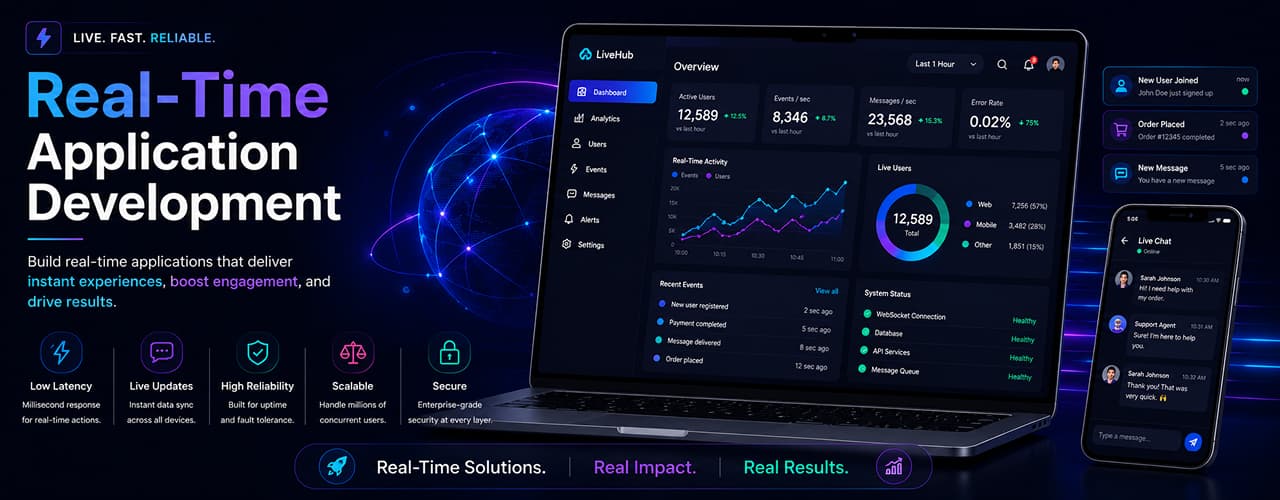
Real-Time Application Development: A Complete Guide
Real-time application development enables software to deliver data, events, and updates on-the-fly without needing the user to refresh the page. It is useful when speed, synchronization, and interaction affect user experience. This approach is especially valuable when time, synchronicity, and interaction are critical elements to the user’s experience.
What is Real-Time Application Development?
Real-time application development is the process of building software that can receive, process, and deliver data with minimal delay. For example, when someone sends a message, the other person receives it instantly without having to refresh the page.
Real-time app development combines a responsive frontend with backend services that manage events, connections, authentication, data storage, and message delivery. An effective process starts by identifying what information should be delivered immediately.
How does Real-Time Application Development Work?
Technologies such as WebSockets provide persistent two-way communication between a client and server. Server-Sent Events, WebRTC, and message brokers could be employed depending on the product.
A suitable real-time application development framework can make communication, state management, authentication, scaling, and error handling easier.
Real-time application development follows a simple event-driven flow:
- An event occurs, such as a message, order, location update, or database change.
- The backend receives and processes the event. Then distributes the relevant update.
- A communication layer distributes the update.
- Connected clients receive the new data.
- The interface updates without a full page reload.
What are Real-Time Applications Used for?
For browser products, real-time web application development is useful for interfaces that require real time updates. Real-time web applications examples include collaboration tools, live sports dashboards, auction platforms, notification systems, and monitoring interfaces.
Real-time application development is valuable when there is a need for up-to-date information or interactivity. The common use-cases are:
- Messaging and chat platforms for instant conversations.
- Live dashboards.
- Financial platforms displaying changing prices and transactions.
- Delivery and logistics systems.
- Collaborative tools.
- Gaming platforms.
- IoT systems.
- Customer support tools.
What is the Difference Between Real-Time and Traditional Applications?
Traditional applications use the request-response approach where the user takes an action, a request is made by the client, and the server responds. Updates may require another request or page refresh.
Real-time application development uses event-driven communication to reduce this delay. The information is sent from the server to the clients upon an event occurrence.
The distinction is how information is delivered. Real-time application development is particularly helpful when information is needed immediately.
What Technologies are Used to Build Real-Time Applications?
The right real-time software development approach should balance performance, reliability, security, and cost.
Real-time application development commonly uses these components:
- WebSockets: Persistent two-way communication
- Server-Sent Events: Server-to-browser updates.
- WebRTC: Peer-to-peer audio, video, and data communication.
- Kafka or RabbitMQ: Event distribution through message brokering.
- Redis: Fast data access, caching, and pub/sub patterns.
- Node.js, Python, or Java: Backend application logic.
- React, Vue, Angular, or mobile frameworks: Responsive interfaces.
- Cloud infrastructure: Deployment and scaling.
What are the Benefits of Real-Time Application Development?
Not every application needs real-time communication. Businesses should identify where immediate updates create value. A focused real-time application development strategy will help in avoiding overbuilding and enhancing user experience.
Real-time application meaning is best understood as software that responds to events and shares information almost instantly.
Real-time application development can provide several practical advantages:
- Faster information delivery: Updates arrive without manual refreshes.
- Better engagement: Immediate responses make applications more interactive.
- Improved visibility: Teams can monitor changing operational data.
- Better collaboration: Users experience less synchronization delay.
- Faster decisions: Current information supports quicker responses.
- Stronger customer experiences: Live notifications, tracking, and communication reduce friction.
Why choose Centrelocus?
Centrelocus approaches real-time application development around business requirements, architecture, scalability, and user experience. Our real-time application development services help businesses build responsive applications with the right technology, communication architecture, and implementation strategy from development to deployment and support.
FAQs
1. What is a real-time application?
A real-time application provides data, events, or any other response with immediate effect.
2. What is a real-time application example?
A live chat app, trading platform, delivery tracker, or collaborative tool is a common example.
3. How do real-time applications work?
They use event-driven communication to send updates between servers and connected clients without repeated page refreshes.
4. What are the benefits of real-time applications?
They improve responsiveness, live connectivity, collaboration, engagement, and availability of up-to-date information.
5. What industries use real-time applications?
Finance, healthcare, logistics, retail, gaming, manufacturing, education, and customer service are typical uses of them.
