
History Of Python Programming Language
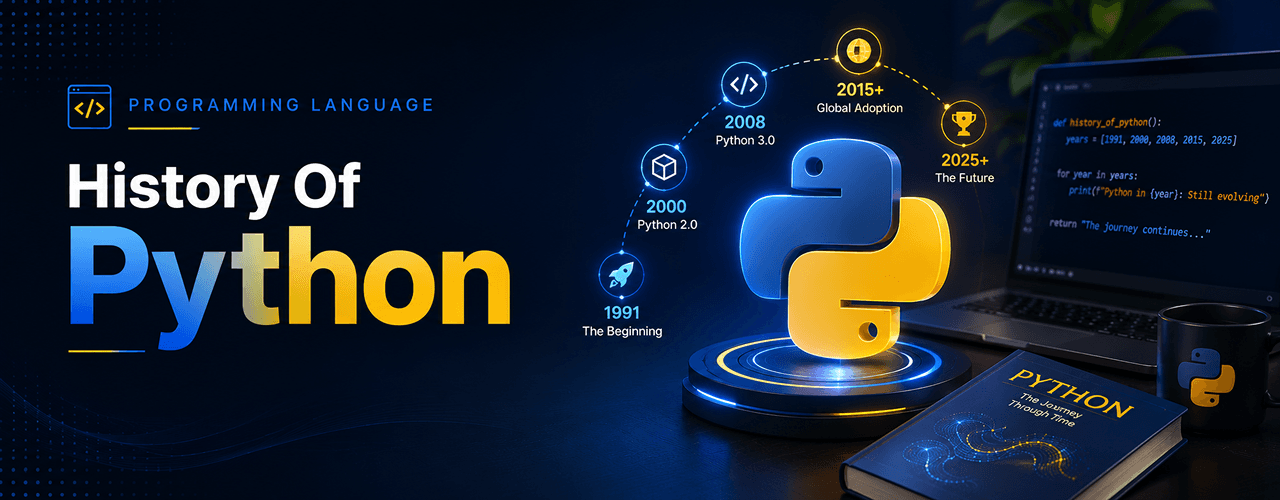
Guido van Rossum developed Python, an interpreted, object-oriented, and high-level programming language.
The design philosophy of the language prioritizes the readability and simplicity of the code, making it a popular option for both inexperienced and seasoned developers. Beginning in the late 1980s and early 1990s, Python has developed into one of the most well-liked and popular programming languages in a variety of fields.
Birth of Python
Van Rossum, a Dutch programmer, started working on Python in December 1989 during his Christmas holidays while working at the Centrum Wiskunde & Informatica (CWI) in the Netherlands. His goal was to create a language that would be easy to read, write and maintain.
Early in the 1990s, Python continued to be developed, and on February 20, 1991, it had its first public release, version 0.9.0 — the first time the programming community saw Python. The language design used elements from several other programming languages, including ABC, Modula-3, C, and others, to produce a flexible and expressive syntax.
Python 2 vs. Python 3
- Python 2.0 was released in 2000 and Python 3 was created and launched on Dec. 3, 2008.
- However, as the language developed, some design choices in Python 2 made it more difficult to maintain and advance the language.
- Python 3 is not fully backward compatible with Python 2 requiring some code adjustments when migrating between versions.
- The most recent stable release of Python 3.10, was officially published on March 24, 2023.
Increased popularity of Python
Python’s popularity has grown over the years due to its readability, adaptability, and simplicity of usage. Its clear and simple syntax was well-liked by developers because it simplified writing and understanding code.
The availability of a sizable standard library and several third-party packages via the Python Package Index accelerated Python’s acceptance. These applications include web development, data analysis, artificial intelligence, scripting, automation, and more.
Final Words
Despite being a powerful and flexible programming language, there are several circumstances where this programming language does not suit best.
Some of such situations include developing real-time systems, memory-intensive software, mobile or console games, facilitating high-frequency trading, system-level programming, and specific cryptographic techniques.
