Machine Learning Governance
Machine Learning Governance: Framework & Components
Machine learning governance is the process of managing machine learning models through clear policies, risk controls, monitoring, documentation, and accountability. It helps businesses ensure that ML systems are accurate, secure, transparent, compliant, and align with the business objectives throughout their life cycle. Effective governance also ensures the responsible adoption of AI through risk assessment and human control.
What is Machine Learning Governance?
Machine learning governance is the structured approach used to manage how machine learning models are developed, deployed, monitored, and retired. This helps in ensuring that the models are reliable, transparent, secure, and in alignment with the organization's objectives.
A practical approach makes it easier for an organization to document the models, assess risk, monitor change, ensure data protection, and have decision-making process
Why is ML Governance Important for Businesses?
Governance is important because machine learning models can influence financial, operational, customer, and strategic decisions. Without clear controls, there could be potential for poor predictions, biases, vulnerabilities in security, compliance issues, or even explainability problems.
A strong governance process helps businesses balance innovation with accountability. Governance will ensure that decisions made through models are easy to evaluate, create ownership and ensure oversight in spite of having many models. The objective for companies that require machine learning governance medium-scale implementation is to have effective controls without much operational complexity.
What are the Key Components of ML Governance?
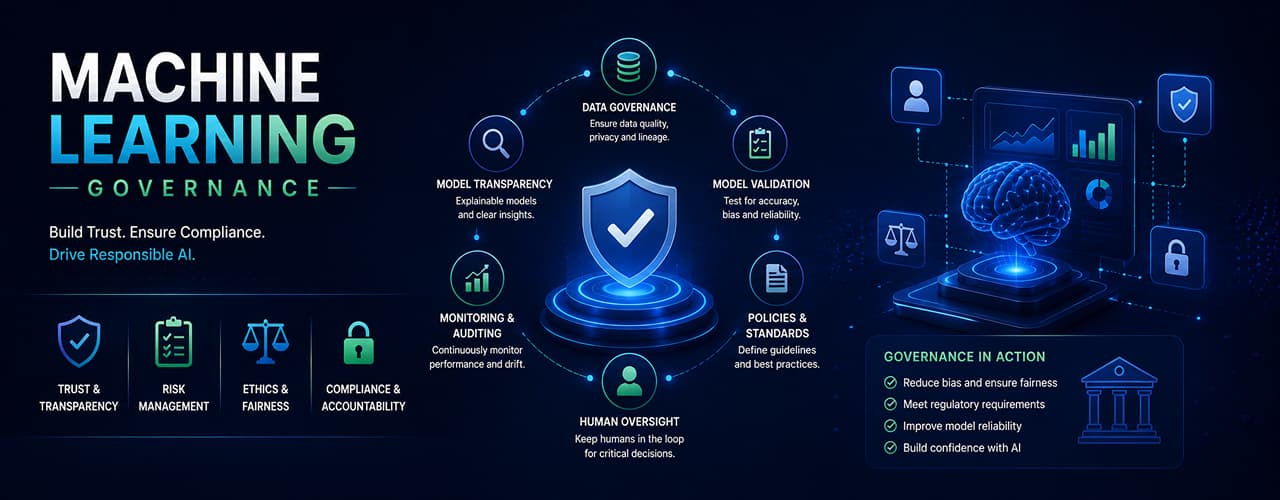
- The main components include model inventory, data governance, risk assessment, documentation, validation, monitoring, access controls, and human oversight.
- A model inventory defines which models are in place and their areas of application.
- Data controls allow verifying that data used for training and production purposes is appropriate and controlled.
- Validation checks the functioning of the model, whereas documentation documents assumptions, limitations, versions, and approval.
- All these elements constitute the core of a governance framework.
- They help businesses establish their standards and define the roles of different teams.
How does a Machine Learning Governance Framework Work?
A machine learning governance framework usually based on the lifecycle of models. At first, the use and possible risks of the model are determined. Then, data analysis, development, validation, decision documentation, and approval are conducted.
After deployment, monitoring becomes essential. Teams track performance, data changes, drift, security events, and other indicators that could affect model reliability. If a model no longer meets defined requirements, it can be reviewed, updated, restricted, or retired.
In practice, the ML governance framework binds all of the above through policies, processes, ownership, and evidence to create a process which is repeatable.
How does ML Governance Manage AI Risk and Compliance?
- Governance supports AI risk management by identifying potential risks before and after deployment.
- Teams can evaluate model accuracy, fairness, privacy, security, explainability, and business impact, then assign controls based on the level of risk.
- A governance process can also support compliance by maintaining documentation, approval records, testing evidence, access controls, and monitoring results.
- In order for governance to be applied effectively in the risk management of machine learning, it should be a continuous process and not just during the implementation of the models.
What are the Best Practices for Effective ML Governance?
Begin with model ownership. All critical models require responsible business and technical ownership. Develop a centralized model inventory and develop consistent criteria for developing, validating, approving, deploying, and monitoring models.
Apply risk-based controls rather than the same processes to all models. Automate documentation and monitoring processes when possible, but maintain human judgment in areas of high impact. Model performance, data quality, security, and compliance requirements should be reviewed frequently.
Organizations can also use machine learning governance examples from different industries to understand how governance controls can be adapted to specific use cases. The goal is not to generate lots of paperwork, but to make model management part of daily routine
Conclusion
Machine learning governance helps businesses manage ML models with greater control, transparency, and accountability. With the combination of policy, risk management, oversight, and monitoring, businesses will be able to create robust AI models.
With the increasing popularity of machine learning, having a good governance model can make scaling easier while minimizing the risks. Centrelocus works to provide businesses with technology solutions that will allow them to build their digital infrastructure.
FAQs
1. What is machine learning governance?
Machine learning governance is the management of ML models using policies, controls, monitoring, risk assessment, and accountability.
2. Why is machine learning governance important?
It helps businesses to enhance ML model reliability, risk management, compliance, and responsible ML usage.
3. How does ML governance manage AI risk?
Risks are identified, analyzed, and managed using controls such as validation, monitoring, documentation, and human intervention.
4. What is a machine learning governance framework?
It includes a systematic set of policies, processes, roles, and controls used to govern ML models.
5. What are some examples of machine learning governance?
Some examples include maintaining a model inventory, performing model validation, managing model drift, documenting decisions, and managing model ownership.
6. What is the role of governance in machine learning?
Governance in machine learning refers to guidelines and controls to ensure that the ML models are reliable, accountable, and controlled throughout the life cycle.
