Logistics Software Development
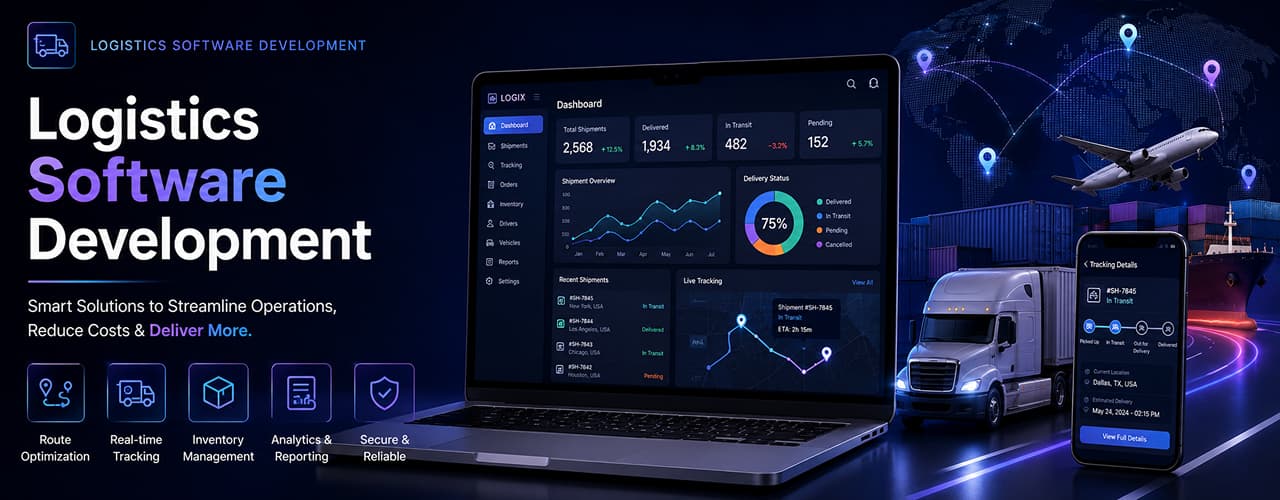
Logistics Software Development: Build Better Logistics Processes
Logistics software development helps businesses manage transportation, shipments, inventory, warehouse activities, delivery operations, and supply chain information through connected digital systems. Businesses no longer have to depend on spreadsheets and phone calls but use centralized systems to make decisions faster.
What is Logistics Software Development?
Logistics software development is the process of designing and building digital applications that help businesses plan, track, coordinate, and optimize logistics activities. The software may be for any operation from transportation, fleet management, warehousing, shipment, delivery, inventory to customer interaction.
Businesses can choose logistics software development services when standard tools do not fully match their processes. A customized solution will allow connecting various operations in one software and supplying needed data to those who need it.
Common examples include:
- Transportation management systems
- Fleet and vehicle management platforms
- Warehouse management systems
- Shipment and order tracking applications
- Supply chain dashboards
How does Logistics Software Development Work?
A typical project starts by understanding business goals, users, existing systems, and operational challenges. After that, the team outlines product requirements and builds realistic road map.
Such an approach is crucial for custom logistics software development, since the product is tailored to the needs of the business, not the other way around.
The process usually includes:
- Discovery: Identify workflows, users, problems, and integrations.
- Design: Plan the interface, architecture, and data flow.
- Development: Build modules, APIs, dashboards, and applications
- Testing: Check security, usability, performance, and reliability.
- Delivery: Launch the platform and provide ongoing support.
What Features Should Logistics Software Include?
Features depend on the operation. Logistics management software development must focus on critical processes.
Mobile accessibility will help drivers, warehouse personnel, and managers get updates even outside the desktop. For complex processes, logistics software development services may help integrate various systems with dashboards.
Useful logistics software solutions often include:
- Shipment and order tracking
- Fleet and driver management
- Route planning and optimization
- Warehouse and inventory visibility
- Delivery scheduling
- Real-time notifications
- Customer and vendor management
- Reporting and analytics
- Role-based access and security
- API integrations with ERP, CRM, payment, mapping, or other systems
How can Logistics Software Improve Supply Chain Management?
With proper design, visibility and coordination can be improved for supply chain operations. Good logistics management software development also helps integrate planning, execution, and reporting activities.
Custom logistics software development services can also support workflows that are unique to an enterprise and help them standardize operations while not losing flexibility.
AI is becoming another practical layer. AI logistics software development may help companies detect patterns, enable better demand forecasting, enhance decision-making on routes, and detect oddities in operations. The goal of AI logistics software development is to aid in decision-making, not to replace systems.
Key benefits include:
- Better visibility: Track shipments, vehicles, orders, and inventory.
- Faster decisions: Respond to delays using current operational data.
- Less manual work: Automate updates, alerts, and data entry.
- Improved coordination: Connect warehouse, transport, delivery, and customer teams.
- Better customer service: Provide clearer shipment and delivery updates.
How much does Logistics Software Development Cost?
Cost depends on project scope. A tracking application will require a different cost from the one that is equipped with fleet, warehouse, mobile, analytics, and integration modules.
Define essential features and users first. This approach would allow a product launch in phases.
Cost can be influenced by:
- Number and complexity of features
- Web and mobile requirements
- Third-party integrations
- UI/UX design requirements
- Security and compliance needs
- AI or automation requirements
- Ongoing maintenance and support
How Long Does it Take to Develop Logistics Software?
The timeline depends on scope, integrations, platforms, and customization. An MVP will take less time than an enterprise platform.
Developing the core processes may reduce the development time of the first release. This is useful for logistics application development when businesses want to validate a solution first.
A roadmap is:
- Planning and discovery
- Design and architecture
- Core development
- Integration and testing
- Launch and improvements
Why choose Centrelocus?
Choose Centrelocus for logistics software development to build scalable, secure, and business-focused solutions tailored to your operational needs. From shipment tracking and fleet management to route optimization and supply chain automation, Centrelocus helps streamline logistics processes and improve visibility. With a focus on modern technologies, user-friendly applications, and flexible software solutions, Centrelocus can help businesses optimize operations, reduce manual work, and deliver better logistics experiences.
FAQs
1. What is logistics software development?
It is the process of building software that manages, tracks, and automates logistics operations. Custom logistics software development services adapt the process to certain workflows.
2. What is the purpose of logistics software?
It provides logistics software solutions to enhance visibility, coordination, tracking, and efficiency.
3. Why do logistics companies need software?
Software makes it easier to decrease manual labor, manage information, track processes, and make decisions quickly.
4. Which software is used in logistics?
Common types include transportation management, warehouse management, fleet management, delivery tracking, and supply chain software.
5. Will logistics be replaced by AI?
No. AI is more likely to replace repetitive tasks and decision-making with humans managing complex operations.
6. Is logistics software suitable for small businesses?
Yes. They can begin with specialized modules and grow subsequently using logistics software development services.
