
Kubernetes Challenges
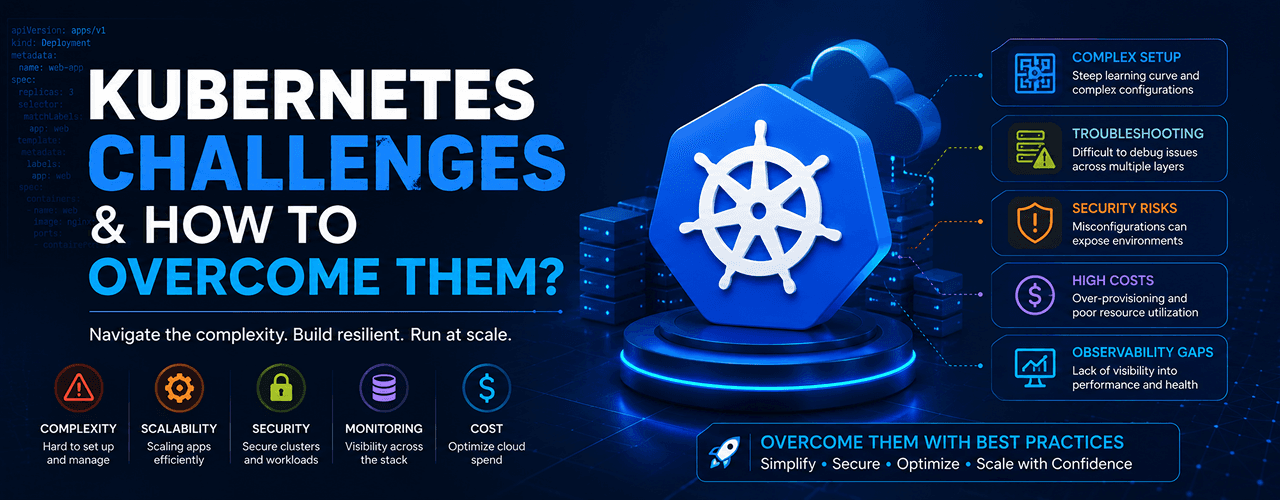
Container orchestration has transformed the way organizations build and manage modern applications. Kubernetes has become the preferred platform for deploying, scaling, and managing containerized workloads across cloud and on-premises environments. However, despite its flexibility and automation capabilities, many organizations encounter significant Kubernetes challenges during implementation and ongoing operations.
Why Kubernetes Adoption Can Be Complex
Although Kubernetes helps with automating deployment, scaling and managing workloads it also brings in a lot of parts that work together. Teams have to handle a lot of things at the time like clusters, networking, storage, keeping an eye on things, security and making sure resources are used properly.
Organizations often underestimate these Kubernetes challenges, resulting in slower deployments, configuration errors, increased costs, and security vulnerabilities.
Cluster Complexity and Operational Overhead
One of the biggest Kubernetes challenges is managing cluster architecture. As applications grow, clusters become increasingly complex with multiple nodes, namespaces, services, and controllers.
Without standardized deployment practices, operational overhead rises significantly.
Best practices include:
- Infrastructure as Code (IaC)
- Automated cluster provisioning
- Configuration management
- Continuous monitoring
- Platform engineering practices
- Real-time analytics and insights
Resource Management and Scaling
Kubernetes is really good at scaling workloads. However when resources are not allocated correctly it can lead to wasted infrastructure. This can also cause the application to slow down.
Many organizations experience challenges with Kubernetes because CPU and memory requests are not optimized. Proper autoscaling policies, workload profiling, and performance testing improve cluster efficiency. Likewise, recurring challenges with Kubernetes can be reduced by continuously monitoring resource consumption and adjusting limits based on real production metrics.
Networking and Service Communication
Container networking introduces additional complexity compared to traditional virtual machines.
Common networking issues include:
- Service discovery
- Network policies
- DNS failures
- Load balancing
- Ingress configuration
- Cross-cluster communication
Multi-Cloud Deployments
Enterprises are using AWS, Azure and Google Cloud more and more to spread out their workloads. This helps them be more resilient and rely less on one vendor.
However, the challenges of multi-cloud Kubernetes optimization include maintaining consistent networking, identity management, storage performance, and policy enforcement across cloud providers. Addressing the challenges of multi-cloud Kubernetes optimization also requires unified monitoring, centralized governance, and automated workload scheduling to ensure operational consistency.
Organizations should adopt centralized management platforms to simplify operations.
Security Risks in Kubernetes
Modern Kubernetes security challenges demand continuous vulnerability scanning, least-privilege access, image validation, and runtime protection. Addressing Kubernetes security challenges early in the development lifecycle significantly reduces security incidents and compliance risks.
Security remains one of the most critical Kubernetes challenges for enterprises.Security needs to be part of DevSecOps pipelines, from the start. It's not a task to be handled after deployment.
Clusters contain numerous attack surfaces including:
- Containers
- APIs
- Nodes
- Secrets
- Service accounts
- Third-party images
Cloud Security Considerations
Many organizations also ask, what are common Kubernetes security challenges in cloud environments?
The answer includes identity management, exposed APIs, insecure container images, excessive permissions, and misconfigured cloud networking.
Understanding what are common Kubernetes security challenges in cloud helps organizations implement zero-trust security, continuous compliance monitoring, and automated policy enforcement before workloads reach production.
Monitoring and Observability
As Kubernetes environments expand, identifying application failures becomes increasingly difficult.
Logs, metrics, and distributed traces originate from multiple sources, making troubleshooting time-consuming.
Effective observability requires:
- Centralized logging
- Real-time dashboards
- Distributed tracing
- Performance monitoring
- Automated alerting
Storage and Persistent Data
Stateful applications introduce additional storage requirements.
Persistent volumes must remain available even if containers restart or migrate between nodes.Planning storage architecture before deployment prevents future operational bottlenecks.
Storage challenges often include:
- Volume provisioning
- Backup management
- Disaster recovery
- Storage class selection
- Performance optimization
Learning Curve and Skill Gaps
Kubernetes has a steep learning curve, especially for organizations transitioning from traditional infrastructure.
Hands-on exercises like the deploy Kubernetes applications on google cloud challenge lab help engineers gain practical deployment experience while understanding production workflows. Many organizations also deploy Kubernetes applications on google cloud challenge lab as part of internal training programs to strengthen cloud-native skills.
Continuous learning reduces deployment risks and improves operational maturity.
Development and operations teams require knowledge of:
- Container orchestration
- YAML configuration
- Networking
- Security
- CI/CD
- Infrastructure automation
Best Practices to Overcome Kubernetes Challenges
Organizations can minimize Kubernetes challenges by adopting a structured implementation strategy.
Recommended practices include:
- Automate deployments using CI/CD pipelines.
- Standardize Infrastructure as Code.
- Continuously monitor cluster performance.
- Implement zero-trust security.
- Regularly update Kubernetes versions.
- Use policy-based governance.
- Optimize resource allocation.
- Perform routine security audits
- Train engineering teams continuously
- Partner with experienced Kubernetes experts when required.
