
Intelligent Automation in Banking
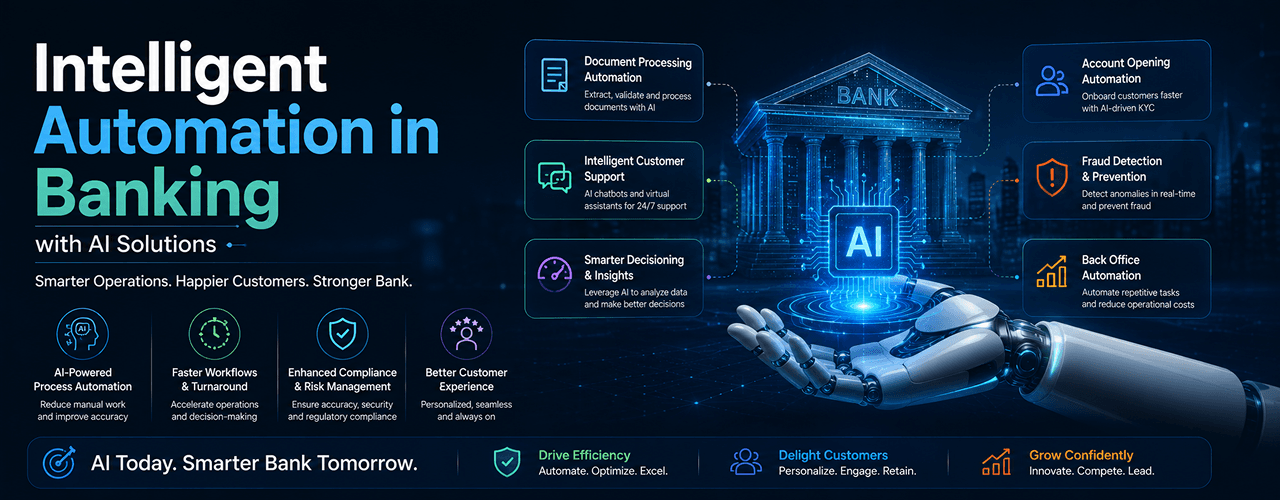
The banking sector is experiencing significant technological change in the form of artificial intelligence, machine learning, cloud computing, and advanced analytics. Of all these technologies, intelligent automation in banking has been proven to be very influential for various reasons.
Banks now handle millions of transactions on a daily basis in addition to onboarding customers, conducting compliance checks, approving loans, detecting fraudulent activities, and delivering customized financial solutions to customers. The conventional processes fail to keep up with the pace of customer needs as well as regulations. Intelligent automation is a mixture of artificial intelligence, machine learning, RPA, NLP, and workflow management.
What is Intelligent Automation in Banking?
The essence of intelligent automation in banking lies in the integration of cognitive technologies and process automation in banking processes. Unlike conventional automation, intelligent automation understands documents, classifies customer queries, identifies anomalies, and makes intelligent decisions.
These technologies work together to automate repetitive processes while continuously learning from new information.
Organizations exploring what is intelligent automation in banking should understand that the technology combines:
- Artificial Intelligence (AI)
- Machine Learning (ML)
- Robotic Process Automation (RPA)
- Natural Language Processing (NLP)
- Intelligent Document Processing (IDP)
- Predictive Analytics
Why Banks Are Investing in Intelligent Automation
The bank sector has faced pressures as a result of digitized customers, fintech players, cybersecurity concerns, and regulatory changes. Intelligent automation in banking supports firms to modernize old processes and enhance their services delivery too.
These benefits allow banks to focus more on strategic growth rather than repetitive administrative work.
Key business advantages include:
- Faster customer onboarding
- Reduced operational costs
- Improved compliance monitoring
- Higher employee productivity
- Better decision accuracy
- Enhanced customer satisfaction
- Scalable banking operations
- Real-time business intelligence
Major Use Cases Across Banking Operations
Modern financial institutions deploy intelligent automation in banking across nearly every department.
Customer Onboarding
Automated document verification processes improve Know Your Customer (KYC) processes and decrease manual work in verification.
Loan Processing
Automation gathers customer data, verifies financial documents, makes credit decisions, and increases approval speed.
Customer Support
Chatbots and AI-powered virtual assistants answer customers' frequently asked questions in real-time and direct them to live people if needed.
Compliance Monitoring
Automation tracks all transactions, customer activities, and any changes in legislation in order to minimize compliance risk.
Claims and Document Processing
Information extraction and document validation are performed by AI using scanned documents.
Intelligent Process Automation vs Traditional Automation
Most firms often mistake RPA with intelligent automation using AI technology. intelligent automation in banking is not limited to only rule-based automation.
Rule-based automation performs repetitive actions according to a set of instructions, whereas intelligent automation uses AI features like understanding unstructured data, pattern recognition, and decision-making.
Because of the above features, intelligent process automation in banking allows for the execution of more dynamic processes such as assessing customer risks, underwriting, and financial analysis.
AI-Powered Fraud Detection
Cybercrime keeps growing at a fast pace, requiring intelligence-based security systems for financial organizations. Modern automated fraud prevention systems using artificial intelligence in banking analyze customer behavior, transaction history, device information, and geographic patterns in real time.
Instead of depending only on static rules, AI keeps learning from new trends of frauds, minimizing false alarms and enhancing accuracy of fraud detection.
As financial threats become increasingly sophisticated, automated fraud prevention systems using artificial intelligence in banking help banks detect suspicious activities before financial losses occur while maintaining seamless customer experiences.
Agentic AI and the Future of Banking Automation
Agentic AI is one of the latest additions in the realm of enterprise AI which allows the creation of autonomous software agents that can plan, reason, and perform multiple-step business processes.
Understanding agentic process automation vs intelligent automation in banking is becoming increasingly important for technology leaders.
While intelligent automation mainly deals with improving current processes with decision making through AI, agentic automation goes a step further and allows autonomous AI agents to coordinate processes and work in conjunction with other systems.
When comparing agentic process automation vs intelligent automation in banking, organizations should evaluate business complexity, governance requirements, compliance obligations, and operational risk before implementation.
Implementation Best Practices
Intelligent automation in banking does not merely require the application of AI tools. It calls for an implementation strategy that is well defined.
Recommended best practices include:
- Look for automation use cases with high impact.
- Develop consistent business process standardization.
- Ensure that enterprise data is of high quality.
- Build a secure cloud-native infrastructure.
- Implement governance and auditing capabilities.
- Educate workers during automation projects.
- Monitor AI models' performance continuously.
- Track KPIs and business success.
Measuring Success
Tracking these metrics enables continuous optimization while demonstrating return on investment.
Organizations implementing intelligent automation in banking should monitor measurable performance indicators, including:
- Loan approval turnaround time
- Customer onboarding duration
- Fraud detection accuracy
- Operational cost savings
- Customer satisfaction scores
- Compliance violation reduction
- Employee productivity improvements
- Process automation rate
The Future of Banking Automation
As generative AI, predictive analytics, cloud computing, and autonomous AI continue evolving, intelligent automation in banking will become central to digital banking strategies. Financial institutions that embrace AI-driven automation today will be better positioned to deliver secure, personalized, and highly efficient banking services tomorrow.
