Generative AI Integration
Scale Your Business with Generative AI Integration
Artificial Intelligence has rapidly evolved from a futuristic concept into a practical business tool. Some of the recent innovations including generative AI integration is helping businesses to automate processes, make better decisions, and deliver a more personalized experience for their customers. Generative AI does not replace the current systems but improves upon them by bringing intelligence and creating new possibilities.Whether you're a startup building an AI-powered product or an enterprise looking to modernize your business infrastructure as a company, integrating generative AI into your applications can create measurable business value.
What is Generative AI Integration?
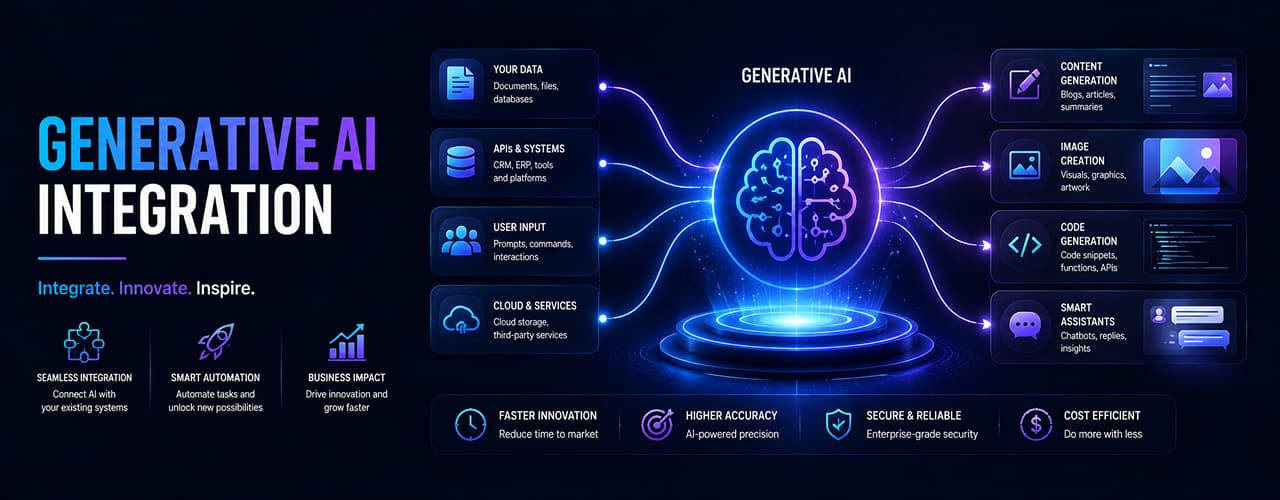
Generative AI integration is the process of implementing generative AI algorithms into your software, website, mobile application or enterprise solution. These AI models can generate text, analyse documents, answer customer queries, summarise information, create content, and automate repetitive workflows.
Modern generative AI integration services make it possible to connect advanced language models with CRMs, ERPs, eCommerce platforms, customer support systems, and internal knowledge bases. Such smart integrations assist companies in working smarter while offering users great experiences.
Why Businesses Need Generative AI
Businesses today face increasing pressure to deliver faster services, cut down on costs and meet customer expectations. AI has proven to be a viable way for accomplishing this.
Many organisations are exploring how to integrate generative AI into their daily operations as AI helps automate tasks, extract information from massive data, and facilitates communication between different departments.
Generative AI integration for businesses enables teams to focus on strategic tasks while the AI performs time-consuming tasks like writing articles, analyzing documents, preparing reports, and answering customer queries.
Benefits of Generative AI Integration
The benefits of generative AI integration extend far beyond automation. Properly deployed AI becomes a great business ally that brings benefits for both the company itself and its clients.
These often discover opportunities to automate operations that were hard or expensive to automate before.
Some of the key advantages include:
- Increased business efficiency via smart automation
- Efficient customer support powered by AI virtual assistants
- Improved content creation for marketing and sales
- Increased efficiency of employees
- Personalized customer experience
- More business insights based on AI-generated analytics
- Cost savings
- Scalability
Step-by-Step Integration Process
A successful AI implementation requires more than simply connecting an API. A structured approach ensures better performance, security, and long-term scalability.
1. Understand Business Goals
Identify the specific problems AI should solve and define measurable outcomes.
2. Assess Existing Systems
Review current applications, databases, and workflows to identify areas of integration.
3. Choose the Right AI Model
Different AI models are suited for different business requirements, from conversational assistants to document analysis and content generation.
4. Prepare Data
Clean, organise, and secure business data before connecting AI systems.
5. Build and Integrate
Implement generative AI integration using secure APIs and scalable cloud infrastructure while ensuring compatibility with existing software.
6. Test and Optimise
Monitor AI response and improve its accuracy on the basis of actual performance.
Businesses should concentrate on optimisation, not just implementation.
Best Practices
In order to increase business value, the best approaches to implementation must be used.
Begin with a clear-cut business objective rather than embracing AI just because it is the latest trend. Make sure that quality data is available for AI processing and governance is in place to use AI responsibly.
Monitor the performance of AI regularly, take feedback from users and tweak the prompt or workflow if necessary.
Companies implementing these practices should also prioritise transparency, security, and human oversight to ensure reliable and ethical AI adoption.
Why Choose CentreLocus for Generative AI Integration?
Choosing the right technology partner is essential for achieving meaningful AI outcomes. CentreLocus brings together technology proficiency and business mindset to develop smart AI solutions and generate value for businesses.
Our team works in collaboration with our clients to find out what their objectives are and how we can integrate our AI-powered applications that align with long-term business strategies.
FAQs
1. What is Generative AI Integration?
Generative AI integration is the process of connecting AI algorithms with other software systems for automation of tasks, content creation, analytics of data, and user experience improvements.
2. How much does AI integration cost?
The cost depends on the complexity of the project, number of features needed, choice of AI model, system integrations, among other factors. Integrations are relatively cheaper than AI systems for enterprises.
3. Is ChatGPT a generative AI?
Yes. ChatGPT is a generative AI application powered by large language models that is used to generate human-like text and help in answering questions and summaries among other business and individual tasks.
4. What are examples of AI integration?
Examples include AI-powered customer support chatbots, document summarisation, intelligent search, CRM automation, emAIl assistants, recommendation engines, content generation, and workflow automation.
5. What is the most famous generative AI tool?
Some of the most widely recognised generative AI tools are ChatGPT, Google Gemini, Claude, Microsoft Copilot, and Meta Llama.
