Generative AI and Machine Learning
What is the Difference Between Generative AI and Machine Learning?
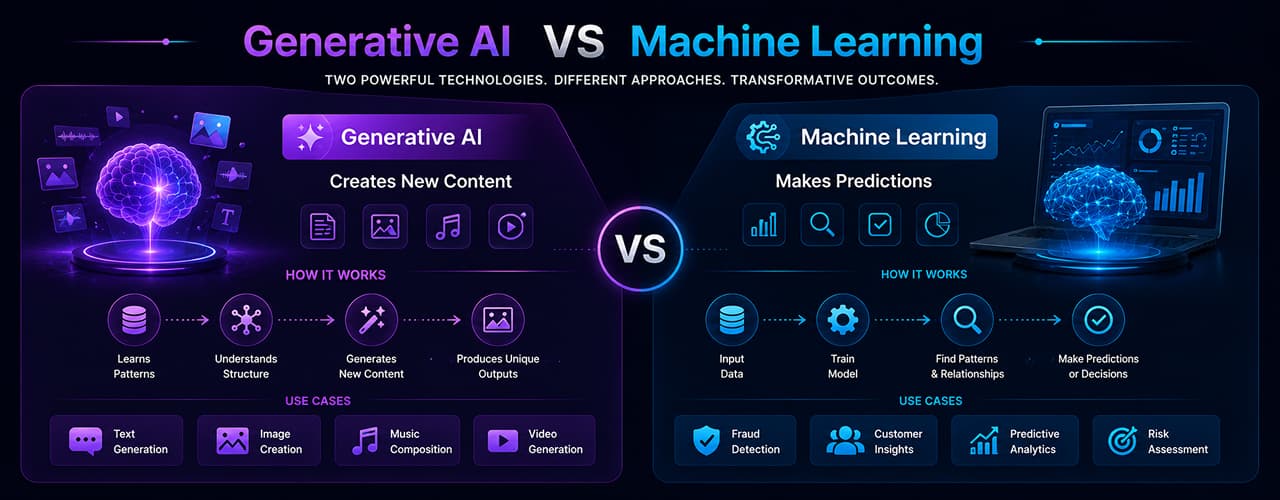
Generative AI vs Machine Learning is not simply a comparison between two competing technologies. Machine learning is a broader field of artificial intelligence in which machines learn the patterns in the data and make predictions or decisions. Generative AI is the more specific field of AI where machines learn to create new content including text, images, code, sound, and more.The easiest way to understand machine learning vs generative AI is this: traditional machine learning usually uses existing data to learn and make predictions/classifications, generative AI learns from patterns in data to generate new content.Understanding the difference between these two technologies will help business organizations choose the most suitable technology for various applications in their work.
What is Generative AI and How Does it Work?
Generative AI is a type of artificial intelligence that can create new content from learning through patterns in datasets.
Modern generative AI systems rely on foundation models, large language models (LLMs), diffusion models, and transformers. Such AI systems are trained on large amounts of data and learn the relationships among various components of the training data.
A simplified process looks like this:
- The model is trained using large datasets.
- It learns patterns and relationships within that data.
- A user provides an instruction or prompt.
- The model processes the input.
- It generates a new output based on learned patterns.
What is Machine Learning and How Does it Work?
Machine learning is a branch of AI that allows computer systems to learn from data and enhance their own performance without any explicit programming.
Machine learning models recognize patterns in the historical data and utilize them to predict, classify, recommend, or make decisions.
Common approaches include supervised learning, unsupervised learning, and reinforcement learning.
A typical machine learning workflow involves data collection, data preparation, choosing the appropriate algorithm, training, performance evaluation, and deployment of the model to a business application.
Generative AI vs Machine Learning: Key Differences
Generative AI vs machine learning can be understood through their primary purpose, output, and typical applications.
Consider generative AI vs machine learning examples. Generative AI can be used to produce a unique product description or even generate summary from a document. Machine learning can be used to identify customer churn or to detect fraud.
This difference does not mean one technology is universally more advanced. They just solve different problems.
- Primary purpose of Generative AI is to creates new content and Machine Learning is to predicts, classifies, or identifies patterns
- Typical output of Generative AI is text, images, code, audio and Machine Learning is predictions, scores, classifications
- Common models of Generative AI is LLMs, diffusion models and Machine Learning is to decision trees, neural networks, regression models
- Typical applications of Generative AI is ai assistants, content generation, code generation and Machine Learning is fraud detection, forecasting, recommendations
- User interaction of Generative AI is often prompt-based and Machine Learning is often data/input-based
How are Generative AI Used in Business?
Businesses use technologies to improve productivity, decision-making, automation, and customer experiences.
Generative AI can support:
- AI-powered customer support
- Content and document generation
- Software code assistance
- Kafka or RabbitMQ: Event distribution through message brokering.
- Knowledge management
- Intelligent search
- Personalized customer interactions
- Workflow automation
How are Machine Learning Used in Business?
Businesses use technologies to improve productivity, decision-making, automation, and customer experiences.
Machine learning can support:
- Predictive analytics
- Demand forecasting
- Fraud detection
- Recommendation engines
- Customer segmentation
- Anomaly detection
- Risk assessment
Which is Better: Generative AI or Machine Learning?
There is no universal winner. The answer varies according to the specific need, the available data, the technology requirements, and the end result.
For generating and transforming content, it might be wiser to opt for a solution that employs generative AI. If you want to forecast, classify, recognize patterns, and predict decisions, it would be wiser to use machine learning.
While asking generative AI vs machine learning which is better, think about the problem first before the solution.
Technology assessment prior to development will help avoid extra complexity and choose a technology that brings business value.
Businesses should consider:
- What problem needs to be solved?
- What data is available?
- What output is required?
- How accurate must the system be?
- Does the application require real-time responses?
- What security and compliance requirements apply?
- How will the solution integrate with existing systems?
Can Generative AI and Machine Learning Work Together?
Yes. Generative AI and machine learning can work together within the same technology ecosystem.
Machine learning can perform analysis of structured business data and generate predictions. Generative AI can further use those insights to generate human-readable descriptions, suggestions, reports, and other outputs.
For instance, an enterprise analytics system may utilize ML algorithms for detecting abnormal sales and use generative AI for explaining the anomaly in natural language.
The combination will make AI systems more efficient as predictive intelligence and content generation help resolve different elements of user experience.
Modern AI systems may also integrate these technologies with APIs, databases, cloud computing, automation systems, and enterprise software solutions.
Generative AI vs Machine Learning: Which One Should You Choose?
Generative AI vs machine learning should be considered more of a business and technical choice than a choice based on trends.
Go for generative AI if your use case requires creation, summarization, transformation or interaction with content. Go for machine learning if you want accurate predictions, classifications, recommendations or pattern identification.
In some cases, the best approach is to use both. An effective architecture for an AI can integrate predictive and generative models and thus come up with an intelligent application that is practical and easy to use.
The future of enterprise-level AI does not lie in the choice of a single technique. Rather, organizations can take advantage of the different kinds of AI techniques in order to produce smarter products and automate their processes.
FAQs
1. What’s the difference between generative AI and machine learning?
Machine learning uses patterns learned from data to make predictions or decisions, whereas generative AI uses learned patterns to generate new content like text, images, code, or audio.
2. What are the disadvantages of generative AI?
Generative AI can create incorrect information, biased material, security threats, and unpredictable output. It might also need a lot of computing power.
3. Is generative AI a type of machine learning?
Yes. Generative AI is a subset of AI which involves machine learning, especially deep learning.
4. Which is better, generative AI or machine learning?
There is no better one; both have their purposes. Machine Learning is more useful for predictions and analysis, whereas Generative AI is good for content generation.
5. Can generative AI and machine learning work together?
Yes. Machine Learning can assist in analyzing data and spotting patterns, and then Generative AI can use that information for content or task generation.
6. Is ChatGPT generative AI or machine learning?
ChatGPT is an example of a Generative AI that utilizes machine learning, particularly large language models (LLMs).
