ERP vs CRM
ERP vs CRM: Choosing the Right Solution
Businesses today rely on technology solutions to improve efficiency, customer relations, and expand their reach. There are two popular platforms that companies use to manage their operations, ERP (Enterprise Resource Planning) and CRM (Customer Relationship Management). Although both solutions increase the efficiency of a company, they play a different role.Understanding ERP vs CRM helps businesses to understand what technology suits their needs, either streamlining internal processes, engaging with customers or combining both of them.
What is ERP?
ERP (Enterprise Resource Planning) is a software solution designed to streamline the operations and processes of an organization through an integrated platform. ERP links various departments within an organization and provides instant access to relevant business information.
The main purpose of ERP is to increase efficiency through automation, reduction of duplicate entries, and decision-making through accurate data.
ERP software is very useful for emerging companies where the efficient management of resources is essential.
An ERP system typically manages areas such as:
- Finance and Accounting
- Human Resources
- Supply Chain Operations
- Inventory management
- Manufacturing
- Procurement
- Reporting and analytics
What is CRM?
CRM (Customer Relationship Management) is a technology solution designed to help businesses manage interactions with current and future clients. The main purpose of CRM is to make customer experience better, improve sales and build relations.
Unlike ERP, which mainly focuses on internal processes, CRM is concerned about customer-oriented activities. The main objective of a CRM is to know customer needs and communicate with him/her.
A CRM system helps organizations manage:
- Lead tracking
- Sales pipelines
- Customer communication
- Marketing campaigns
- Customer support
- Customer data analysis
ERP vs CRM – Key Differences
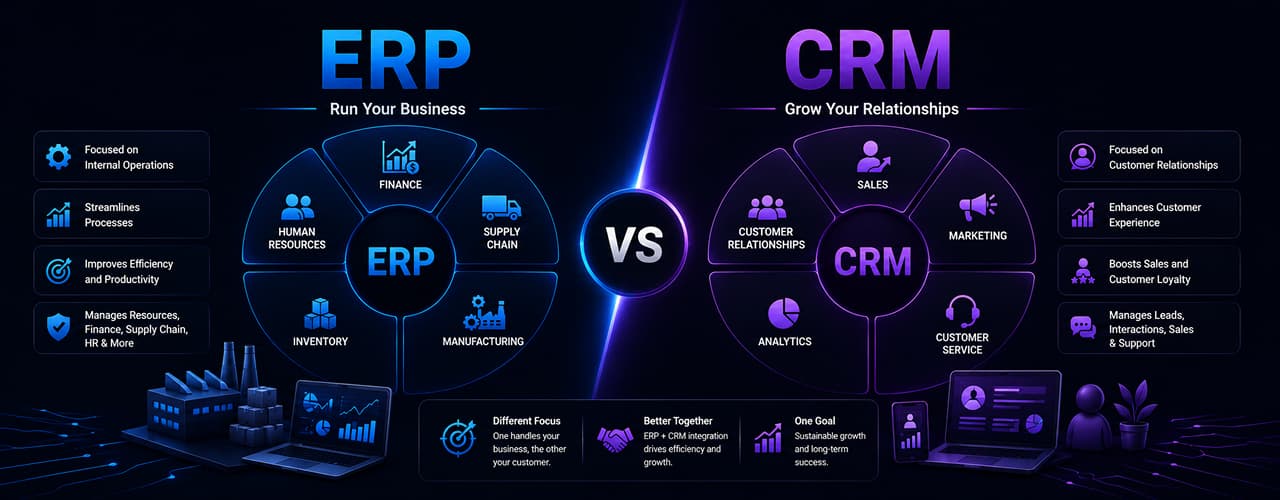
ERP vs CRM lies in their primary objectives. ERP aims to handle business processes, while CRM aim to manage relationships with clients.
While comparing CRM vs ERP, it should be noted that neither of these systems can replace each other. It all depends on business needs.
- Main Purpose : ERP manage internal business processes and CRM manage customer relationships
- Primary Users : ERP primary users are Finance, operations, HR, supply chain teams and CRM primary users are Sales, marketing, and customer support teams
- Focus Area : ERP focus on resources, processes, and productivity and CRM focus on customers, sales, and engagement
- Data Managed : ERP manage financial, operational, and business data and CRM manage customer and sales-related data
- Main Goal : ERP improve efficiency and control and CRM increase sales and customer satisfaction
ERP and CRM Similarities
Although ERP and CRM serve different functions, they have several similarities. Both enable companies to manage their data, automate their work processes, aid in decision making, and enhance productivity.
Both solutions are aimed at enhancing efficiency and making decisions based on information.
Some key similarities include:
- Centralized data management
- Process automation
- Reporting and analytics
- Cloud-based accessibility
- Improved collaboration between teams
ERP vs CRM: Which One Does Your Business Need?
Choosing between ERP or CRM depends on issues faced by your business.
Businesses that need better control over internal operations may benefit from ERP. For example, companies struggling with inventory management, financial reporting, supply chain coordination, or resource planning can use ERP to improve efficiency.
On the other hand, businesses focused on increasing sales, managing customer interactions, and improving marketing performance may require CRM.
ERP CRM comparison is therefore essential to ensure that companies choose systems that will help them grow in the future.
A simple way to decide:
- Choose ERP if your priority is improving internal operations.
- Choose CRM if your priority is improving customer relationships.
- Choose both if you need complete business management and customer engagement solutions.
Can ERP and CRM Work Together?
Yes, ERP and CRM can work together to create a more connected business environment. Integrating both systems allows companies to combine operational data with customer insights.
Many organizations use integrated solutions to create a complete digital ecosystem that supports both operational excellence and customer satisfaction.
The integration of ERP vs CRM provides:
- Better data visibility
- Improved team collaboration
- Faster decision-making
- Enhanced customer experiences
- More accurate business forecasting
ERP and CRM Benefits
Some important ERP and CRM Benefits include:
Benefits of ERP:
- Improved operational efficiency
- Better resource management
- Reduced manual processes
- Accurate reporting
- Enhanced productivity
Benefits of CRM:
- Better customer relationships
- Improved sales management
- Higher customer retention
- More effective marketing strategies
- Better understanding of customer behavior
Conclusion
Understanding ERP vs CRM is essential for businesses looking to invest in the right technology solution. While ERP helps manage internal operations, CRM focuses on improving customer relationships. Many growing organizations benefit from using both solutions together for better efficiency and customer engagement.
As a technology partner, Centrelocus helps businesses develop customized software solutions that support digital transformation, operational improvement, and sustainable growth through modern enterprise technologies.
FAQs
1. Is ERP better than CRM?
ERP and CRM have different uses, thus neither is better than the other. ERP is better in management of internal functions, whereas CRM is better at management of customer relations and sales.
2. Can a company use both ERP and CRM?
Yes, companies can use both ERP and CRM together. Integration between these systems makes it easy for the company to manage its operations while maintaining good customer relations.
3. What is the difference between a CRM and ERP?
The difference between ERP and CRM is that ERP handles internal functions of the business such as finance, inventory, and operations, while CRM handles customer relations and sales
4. What are the 4 types of CRM?
The four common types of CRM are operational CRM, analytical CRM, collaborative CRM, and strategic CRM. Each has different areas of focus within customer and business relations.
5. Can a business use both ERP and CRM?
Yes, businesses of all sizes can use both systems. The combination of ERP and CRM allows companies to develop more effective workflow processes and attain business success.
