Digital Transformation Services
What Are Digital Transformation Services and How Do They Help Businesses?
Businesses need connected systems, efficient workflows, useful data, and digital experiences that can grow with customer expectations. Digital transformation helps organizations bring these elements together to better their business operations, customer service and decision making.
What are Digital Transformation Services?
Digital transformation services are technology-led services that enable a business to transform its processes, systems, customer experience, and operating model. The point is not to transform everything at once but only those areas where technology can produce measurable impact.
In simple terms, the goal is to use modern technology to get better solutions for business problems via cloud adoption, integration, automation, AI, or software modernization.
Why Does Your Business Need Digital Transformation Services?
The growth of businesses results in problems such as delay, duplication, disconnected data and increased cost for which transformation comes into picture.
Digital transformation in business is more than IT. It brings together technology spending and operations.
Digital transformation services can help businesses:
- Reduce repetitive manual work through automation.
- Connect data and applications across departments.
- Improve customer and employee experiences.
- Make business information easier to access.
- Scale technology as business requirements change.
- Support faster and more informed decision-making.
What do Digital Transformation Services Include?
These services can be provided independently or as part of digital transformation services as a whole.
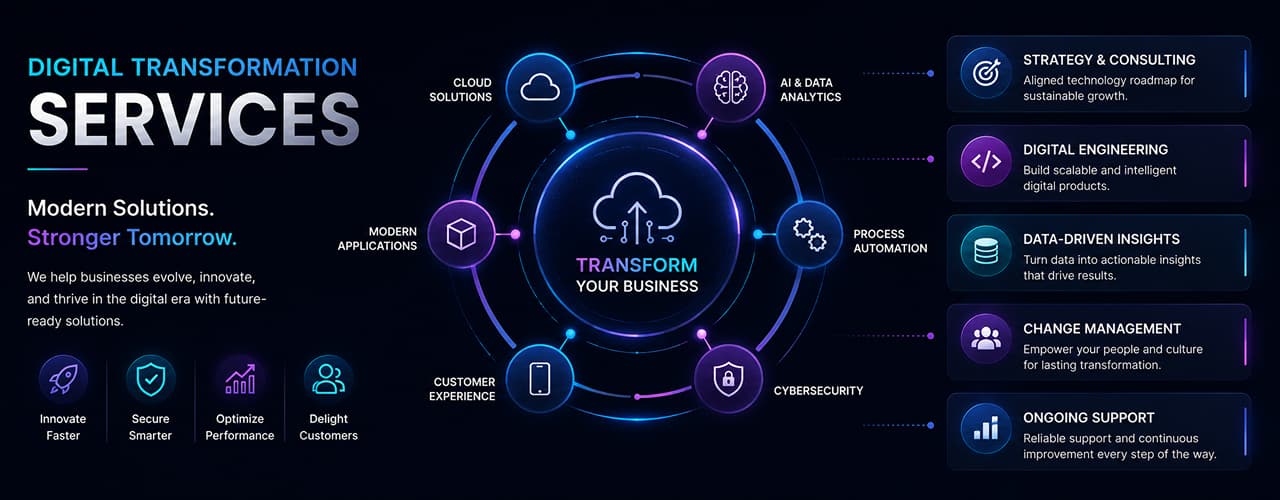
The scope depends on business objectives and current technology. Common areas include:
- Cloud migration and DevOps: Flexible infrastructure and faster software deployment.
- Enterprise software modernization: Improved performance and maintainability for aging applications.
- Legacy system integration: Connections between older platforms and modern applications.
- IT consulting and strategy: Clear technology priorities and transformation roadmaps. Digital transformation consulting services can help organizations choose practical initiatives and implementation priorities.
- AI and automation: Streamlined workflows and intelligent decision-making.
- Custom software development: Technology designed around specific business requirements.
How are Generative AI Used in Business?
Businesses use technologies to improve productivity, decision-making, automation, and customer experiences.
Generative AI can support:
- AI-powered customer support
- Content and document generation
- Software code assistance
- Kafka or RabbitMQ: Event distribution through message brokering.
- Knowledge management
- Intelligent search
- Personalized customer interactions
- Workflow automation
How do Digital Transformation Services Work?
A successful transformation starts with the business goal rather than only the technology. This involves identifying obstacles, setting measurable objectives, and finding the best method to implement.
A simple transformation process typically includes:
- 1. Discovery – Understand business challenges, users, existing systems, and requirements.
- 2. Strategy – Prioritize initiatives, define the roadmap, and establish success measures.
- 3. Design – Plan workflows, architecture, integrations, and user experiences.
- 4. Development – Build, configure, integrate, and test the required solutions.
- 5. Deployment – Launch the solution carefully and monitor performance.
- 6. Optimization – Improve the system using feedback, data, and changing business needs.
How can Digital Transformation Improve Business Efficiency?
Transformation can improve efficiency by removing friction from everyday operations. Where systems are linked and routine processes are automated, employees are able to focus on tasks that require thinking, imagination, and client interaction.
For example, a company may automate data entry, connect its CRM with other applications, or use dashboards to bring key information into one view.
The success of transformation is dependent on many factors, such as your initial position and implementation quality.
Benefits can include:
- Faster workflows and approvals
- Fewer manual errors
- Better visibility into operations
- Easier collaboration between teams
- More consistent customer experiences
- Improved ability to respond to market changes
Which Technologies are Used in Digital Transformation Services?
Modern transformation can combine several technologies. This will depend on the issue that needs solving.
Common technologies include:
- Cloud computing for scalable infrastructure and application hosting.
- Artificial intelligence and machine learning for automation, prediction, and insights.
- APIs and integration platforms for connecting applications and data.
- Data analytics and business intelligence for clearer decision-making.
- Microservices and modern architectures for flexible software systems.
- DevOps and CI/CD for faster, more reliable software delivery.
- Cybersecurity technologies for protecting applications, systems, and information.
What are the Benefits of Digital Transformation Services?
When aligned with business needs, transformation can improve operations, technology, and customer experience.
Enterprise digital transformation can be particularly useful for businesses dealing with complex systems, different departments, large amounts of data, or legacy systems. A staged process makes it easier to manage and evaluate big transformations.
Application modernization is another method that can assist in leveraging the potential of already existing software by making improvements rather than implementing a full replacement right away.
Key benefits include:
- Higher operational efficiency through automation.
- Better scalability as workloads and customer demand increase.
- Improved access to reliable business data.
- Faster development and deployment cycles.
- More personalized digital customer experiences.
- Stronger integration between business systems.
- Greater flexibility when market conditions change.
- A technology foundation that supports long-term innovation.
Why Choose Centrelocus?
Centrelocus is a digital transformation company that combines AI, cloud, data, modern software development, and intelligent automation to help organizations build future-ready digital solutions. The process involves discovery, design, development, and delivery for aligning technology and business needs. Our solutions include AI, blockchain, software development, mobile application development, and pre-built solutions.
Centrelocus offers digital transformation services focused on scalable solutions and practical technology adoption.
FAQs
1. What are digital transformation services?
Digital transformation services assist organizations in achieving modernization by utilizing technology like AI, cloud, automation, and custom software solutions.
2. What are digital transformation tools?
Digital transformation tools are technologies used to improve business operations, including AI platforms, cloud solutions, automation tools, analytics, CRM, and enterprise software.
3. How is AI used in digital transformation?
AI is used to automate processes, analyze data, make decisions, personalize customer experience, and develop intelligent applications.
4. Why is digital transformation important for businesses?
Digital transformation helps businesses improve efficiency, reduce costs, enhance customer experiences, and adapt faster to changing market demands.
5. What are the key components of digital transformation?
Key components include cloud computing, AI, automation, data analytics, modern software, cybersecurity, and digital customer experiences.
6. How do companies start digital transformation?
Usually, companies will begin with an analysis of their existing processes, technology gaps, and business objectives before taking action.
