CRM Application Development
CRM Application Development: Create a Smarter Customer Management System
Businesses need more than a place to store customer details. They need a system that connects leads, sales, communications, services, and reporting into one workflow. CRM application development ensures that businesses create a customer management process based on what the business does and not vice versa.
What is CRM Application Development and How Does it Work?
CRM application development involves the design, creation, testing, and maintenance of a customer relationship management application. Its purpose is to ensure that customer data is centralized and that daily sales and services are made easier.
A practical process includes:
- Discovery: Define goals, users, workflows, and integrations.
- Design: Plan user journeys and system architecture.
- Development: Build the application, database, APIs, and modules
- Testing: Check security, usability, performance, and data accuracy.
- Deployment: Launch, monitor, and improve the solution.
Why Does Your Business Need a Custom CRM Application?
A custom CRM is useful when there is no other CRM platform that can align with your sales process, customer journey, reports, or technology. You can prioritize workflows that directly support daily operations.
The right CRM software should make work easier rather than harder.
A tailored solution can help businesses:
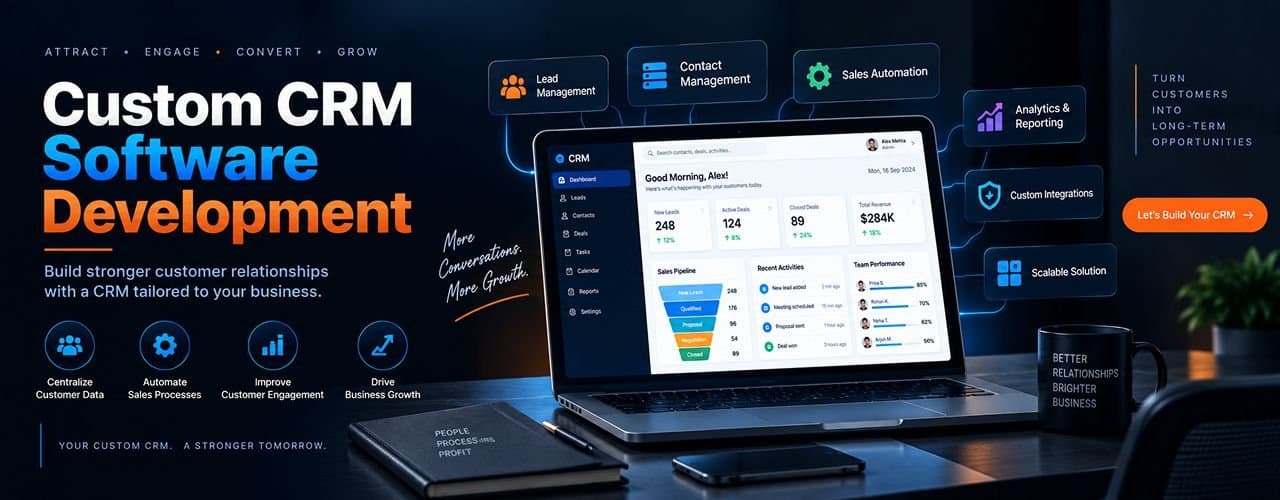
- Centralize customer information
- Automate follow-ups
- Track leads through sales stages
- Connect business tools
- Create useful reports
What Features Should a Modern CRM Application Include?
CRM software examples can range from contact management software to enterprise solutions that provide automation and analytics functionality. The team needs to identify their requirements first.
Effective CRM application development involves addressing practical issues rather than creating additional features.
Features should reflect business needs, not a checklist. Common capabilities include:
- Lead and contact management
- Sales pipeline and opportunity tracking
- Task and follow-up automation
- Email and communication management
- Support and ticketing
- Dashboards and analytics
- Role-based access
- API integrations
- Mobile access
How Much Does CRM Application Development Cost?
There is no single fixed price. If you ask, how much do CRM development companies charge for custom applications, it would depend on many factors including features, integration, design requirements, security, technology, migration, and support services.
CRM solutions can be based only on the basic sales and contacts modules or it can include complex workflow, analytics, integration capabilities, migration of legacy data.
Before estimating a project, define:
- Core features and roles
- Required integrations
- Web, mobile, or both
- Data migration
- Security and support needs
How Long Does It Take to Develop a CRM Application?
There is no universal timeline. A focused MVP is usually simpler than an enterprise platform that integrates with other software.
The best way forward would be to launch the MVP, gather feedback, and improve the process through iterations. This keeps development aligned with real business needs.
The CRM app development timeline depends on:
- Number and complexity of features
- UI/UX requirements
- Integrations
- Data migration
- Testing
- Feedback cycles
What is the Difference Between Custom CRM and Off-the-Shelf CRM?
An off-the-shelf CRM provides ready-made features when your processes closely match the product. Custom CRM will be built based on your processes and future requirements.
This decision will depend on business suitability, cost, scalability, and control in the long run. The CRM application development tools should suit security, technical requirements, expertise, and scalability.
Choose custom development when you need:
- Unique workflows
- Specialized reporting
- Deep system integration
- Greater control over data
- Room to evolve
How Can a CRM Application Improve Sales and Customer Management?
A well-designed CRM provides better insights into customer behavior and allows for actions to be taken at the appropriate time rather than searching through spreadsheets and emails.
Good CRM application development is not so much about an endless array of features but rather making the right decisions.
Key benefits include:
- Better lead visibility
- Consistent sales processes
- Faster access to customer history
- Automated routine activities
- Useful reporting
- Better sales and support coordination
Why Choose Centrelocus for CRM Application Development? Why Choose Centrelocus for CRM Application Development?
Centrelocus builds custom software around business requirements, scalable architecture, usability, security, and maintainability. Development services offered by Centrelocus include custom development, web applications, enterprise development, integration, and CRM solutions.
Its development methodology discovery, design, development, and deployment, focusing on requirements, architecture, testing, security, and improvement.
For businesses seeking CRM application development services, Centrelocus can convert their business operations into CRM solutions.
FAQs
1. Why choose custom CRM application development?
With custom CRM development, companies can build their workflows, integration, reporting, and functionality according to their needs.
2. Can CRM applications be customized for different industries?
Yes. CRM applications can be adapted for real estate, healthcare, education, finance, retail, and professional services.
3. Can a CRM application be developed for mobile devices?
Yes. A CRM can be responsive or developed for Android and iOS.
4. How to build a CRM application?
Start with requirements, create MVP, design user experience, select the technology stack, build and test the application, deploy and optimize it.
5. Is CRM easy to learn?
Yes, when the interface and workflows are designed around how users actually work.
6. Will CRM be replaced by AI?
AI is more likely to enhance CRM systems than replace them. It can automate tasks, summarize interactions, identify patterns, and support decisions.
