Cloud Application Development
Cloud Application Development for Scalable Digital Solutions
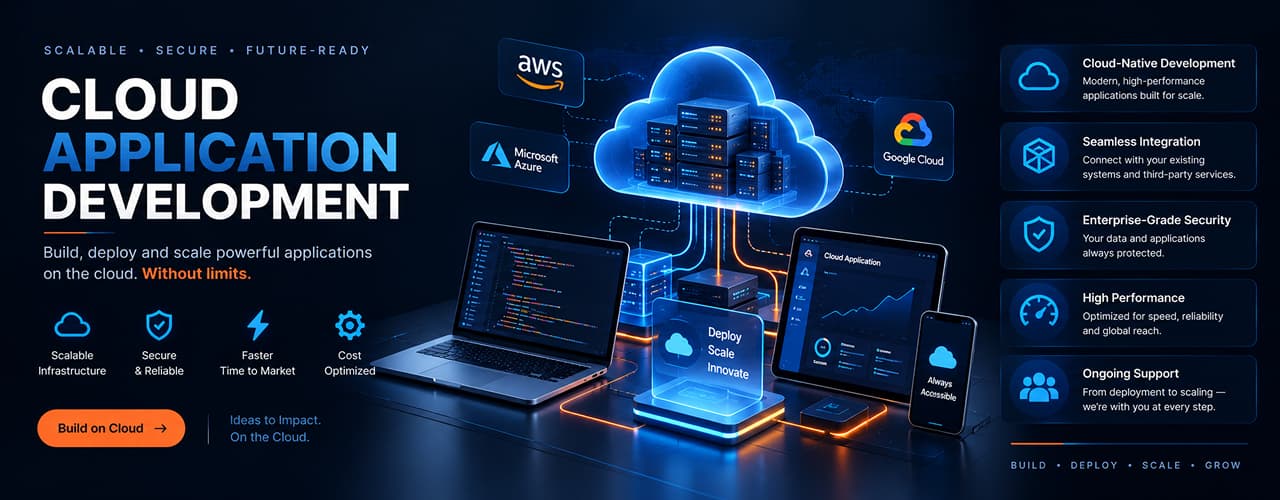
Businesses need applications that can scale quickly, remain accessible, and adapt to changing customer expectations. Cloud application development is one way in which businesses can develop software applications through the use of cloud infrastructure and technologies. It supports faster deployment, flexible scaling, easier integration, and improved operational efficiency. From startups to enterprises, cloud-based applications can help in efficient and flexible deployment, scalable integration and better operational efficiency.
What is Cloud Application Development?
Cloud application development refers to the designing, building, testing, implementing and maintenance of applications using cloud-based infrastructure and services. Unlike applications designed only for traditional local environments, cloud applications can use resources such as cloud computing, databases, storage, APIs, containers, and automated deployment platforms.
How Does Cloud Application Development Work?
The process combines application architecture with cloud infrastructure. The developers first understand the business needs and then select a suitable architecture, technologies, database, and cloud environment.
This makes cloud application development more flexible to changing business requirements.
A typical workflow includes:
- Requirement analysis: Define business objectives, users, features, and technical requirements.
- Architecture planning: Select the application architecture, cloud model, APIs, databases, and infrastructure.
- Development: Build the frontend, backend, APIs, integrations, and core functionality.
- Testing: Check functionality, security, performance, compatibility, and reliability.
- Deployment: Release the application through a suitable cloud environment.
- Monitoring and optimization: Track application performance and continuously improve the system.
What are the Benefits of Cloud Application Development?
For organizations that are planning to grow digitally in the long run, it could be worthwhile for them to use cloud application development as a platform to base themselves on.
Cloud-based applications offer many benefits for both small and big businesses.
- Scalability: Resources can be adjusted as application traffic changes.
- Cost flexibility: Businesses can optimize infrastructure spending based on usage.
- Accessibility: Applications can support users across locations and devices.
- Faster deployment: Automated development and deployment practices can shorten release cycles.
- Business continuity: Cloud infrastructure can support backup, recovery, and resilient application architectures.
- Easier integration: Cloud applications can connect with APIs, third-party platforms, analytics tools, and enterprise systems.
What Types of Applications Can Be Built in the Cloud?
A well-designed cloud-native application development strategy can ensure that the applications can leverage services like containers, microservices, serverless computing, managed databases, and scalability.
Cloud platforms can support many application categories, depending on the requirement and architecture. Common examples include:
- SaaS and subscription-based applications
- Enterprise business applications
- Customer portals and dashboards
- E-commerce platforms
- Financial and analytics applications
- Healthcare and education platforms
- Collaboration and productivity tools
- Mobile and web applications
- AI-enabled business applications
What are the Key Steps in Cloud Application Development?
For businesses asking how to develop cloud applications, the answer will depend on certain aspects like the application complexity, traffic, security needs, budgets, etc.
Successful development starts with a clear technical and business roadmap. The major steps include:
- Define business goals and user requirements.
- Select the appropriate cloud architecture and technology stack.
- Design the application's user experience and system architecture..
- Develop and integrate application components.
- Implement security, testing, and quality controls.
- Deploy the application and configure monitoring.
- Optimize performance and maintain the application over time.
Which Cloud Technologies are Used for Application Development?
Modern cloud projects can combine several technologies rather than relying on a single platform. Common choices include:
- Cloud platforms: AWS, Microsoft Azure, and Google Cloud
- Containers: Docker
- Orchestration: Kubernetes
- Databases: PostgreSQL, MySQL, MongoDB, Redis, and cloud-managed databases
- Development: React, Next.js, Vue.js, Node.js, Python, .NET, and Java
- DevOps: CI/CD pipelines, infrastructure automation, monitoring, and testing tools
Why Choose Centrelocus for Cloud Application Development?
Choosing the right technology partner is important because cloud projects require more than application coding. Architecture, security, scalability, deployment, testing, and maintenance all play a role in the outcome.
Centrelocus combines software development with cloud, AI, data, and modern digital transformation capabilities. Its development methodology follows a structured Discovery, Design, Development, and Deployment approach, supported by Agile and DevOps practices.
Its cloud application development services can be aligned with business requirements ranging from modern web applications to scalable enterprise solutions. Centrelocus also demonstrates capabilities across frontend and backend development, API integration, security implementation, testing, performance optimization, and cloud deployment.
FAQs
1. What is cloud application development?
It is the process of building, deploying, and maintaining applications using cloud infrastructure and services.
2. What are the techniques for cloud application development?
Common techniques include microservices, containers, serverless architecture, APIs, DevOps, CI/CD, and automated scaling.
3. What is the difference between cloud application development and traditional application development?
Cloud development uses cloud infrastructure for scalability, accessibility, and flexible resource management, while traditional development may depend more heavily on local infrastructure.
4. Is cloud application development suitable for small businesses?
Yes. It can help small businesses access scalable infrastructure without making large investments in physical servers.
5. How secure are cloud applications?
Cloud applications can be highly secure when developers implement encryption, authentication, access controls, monitoring, secure APIs, and regular security testing.
