Claude vs Codex
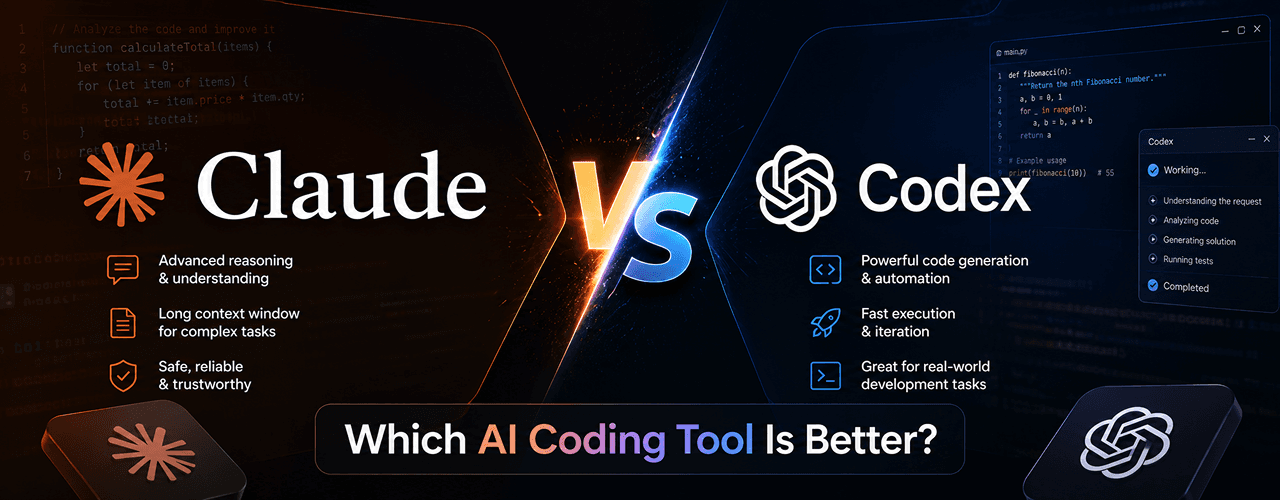
Claude vs Codex comparison for businesses and developers. Discover which AI coding assistant offers better performance for your needs.
Artificial Intelligence is transforming the way software development takes place today. Developers today are no longer limited to traditional Integrated Development Environments (IDEs). Instead, they are increasingly adopting AI coding assistants to write code faster, debug applications, automate repetitive tasks, and improve software quality.Among the leading AI-powered coding assistants available today, Claude by Anthropic and Codex by OpenAI have proven to be two of the best in the field. While both platforms are capable of generating code and assisting developers, they are designed with different philosophies and excel in different scenarios.But, which one should developers and businesses choose?In this comprehensive comparison, we will compare Claude with Codex in detail, highlighting their strengths, limitations, ideal use cases, and what software teams should consider before integrating either solution into their development workflow.
What is Claude?
Claude is a family of large language models built by Anthropic with particular emphasis on reasoning, safety, and long-context understanding.
Unlike traditional code completion tools, Claude is a smart software engineering assistant that can:
- Understanding large codebases
- Explaining complex algorithms
- Refactoring legacy applications
- Writing technical documentation
- Debugging code
- Assisting with software architecture decisions
What is Codex?
Codex is OpenAI's coding-focused AI model designed specifically for use in software engineering projects.
Originally powering GitHub Copilot, Codex has since developed into an AI code-writing tool capable of:
- Develop production-ready code
- Generating unit tests
- Creating APIs
- Refactor applications
- Fixing bugs
- Executing multi-step development tasks
Claude vs Codex: Feature Comparison
- Code Generation of Claude is Excellent and also of Codex is Excellent
- Long Context Handling of Claude is Outstanding and of Codex is Very Good
- Code Refactoring of Claude is Excellent and also of Codex is Excellent
- Software Architecture Discussions of Claude is Excellent and of Codex is Very Good
- Multi-file Understanding of Claude is Outstanding and of Codex is Excellent
- Automated Coding Tasks of Claude is Good and of Codex is Excellent
- IDE Integration of Claude is Limited and of Codex is Strong
- Technical Documentation of Claude is Excellent and of Codex is Very Good
- Reasoning Capability of Claude is Outstanding and of Codex is Excellent
Code Generation Quality
Claude generally generates very readable code, complete with explanations. Developers often appreciate its ability to explain why a particular implementation is chosen.
Codex focuses more on practical implementation and efficient execution. It tends to generate concise, production-oriented code that aligns well with professional development practices.
Both Claude and Codex generate high-quality code in various languages such as:
- Python
- JavaScript
- TypeScript
- Java
- C#
- Go
- PHP
- Rust
- SQL
Context Window and Large Projects
One of Claude's strongest capabilities is handling extremely large amounts of context.
Large enterprise applications often contain:
- Hundreds of files
- Multiple microservices
- Complex documentation
- API specifications
- Database schemas
Software Engineering Workflow
Claude shines during planning, analysis, and technical conversations. It acts almost like an experienced software architect who can explain trade-offs and suggest better options.
Codex is optimized for executing engineering tasks efficiently. It is particularly effective when developers require AI support while writing code.
Modern software development involves much more than just code writing.
Developers spend time:
- Reading existing code
- Planning features
- Fixing bugs
- Writing documentation
- Reviewing pull requests
- Refactoring systems
Debugging and Code Review
Debugging is another area where both tools demonstrate strong capabilities.
Claude often excels in finding the root cause of any problems by thoroughly examining the code flow and reasoning.
Codex focuses on identifying errors, proposing fixes, and generating updated implementations that developers can quickly integrate into their projects.
Both save plenty of time compared to manual inspection.
Technical Documentation
Documentation remains one of the most overlooked aspects of software engineering.
Because of Claude’s capabilities to write structured explanations, it is useful for enterprise organizations.
Codex can also produce documentation but its main aim is software development and not documentation.
Claude performs exceptionally well when generating:
- API documentation
- Architecture documents
- Design specifications
- Technical reports
- Developer guides
AI-Assisted Development Speed
Both Claude and Codex can contribute to rapid software development; however, the benefits will vary depending on project complexity and AI usage by developers.
Neither tool replaces software engineers. Instead, they assist developers to work on business problems and not repetitive tasks.
Coding assistance from AI can significantly increase developer productivity.
Common productivity improvements include:
- Faster code generation
- Reduced debugging effort
- Automated boilerplate creation
- Improved code consistency
- Quicker onboarding for new developers
Which AI Coding Assistant Is Better?
The answer depends on the specific use case.
Choose Claude if your team primarily needs:
- Software architecture discussions
- Technical documentation
- Long-context analysis
- Code explanation
- Legacy system understanding
- Design reviews
Choose Codex if your team primarily needs:
- Production-ready code generation
- Automated coding workflows
- Developer productivity
- Efficient implementation
- Task execution
- Software engineering automation
The Future of AI Software Development
AI-assisted software engineering is evolving rapidly.
Modern development teams increasingly rely on AI for:
- Intelligent code generation
- Automated testing
- Security analysis
- Infrastructure automation
- Documentation generation
- Continuous code review
Final Thoughts
The Claude vs Codex debate does not have a universal winner because both tools are designed with different priorities.
Claude stands out for deep reasoning, long-context understanding, and technical communication. Codex excels with its software engineering, code generation, and code execution abilities.
For organizations building modern digital products, the best choice depends on team structure, project requirements, and development objectives.
At Centrelocus, we continuously evaluate emerging AI technologies to help businesses adopt the right tools for their engineering goals. Whether it involves AI software development, enterprise application development, custom software solutions, or AI-powered automation, selecting the appropriate AI coding assistant is only one part of building scalable, future-ready software.
