
BLE System Integration
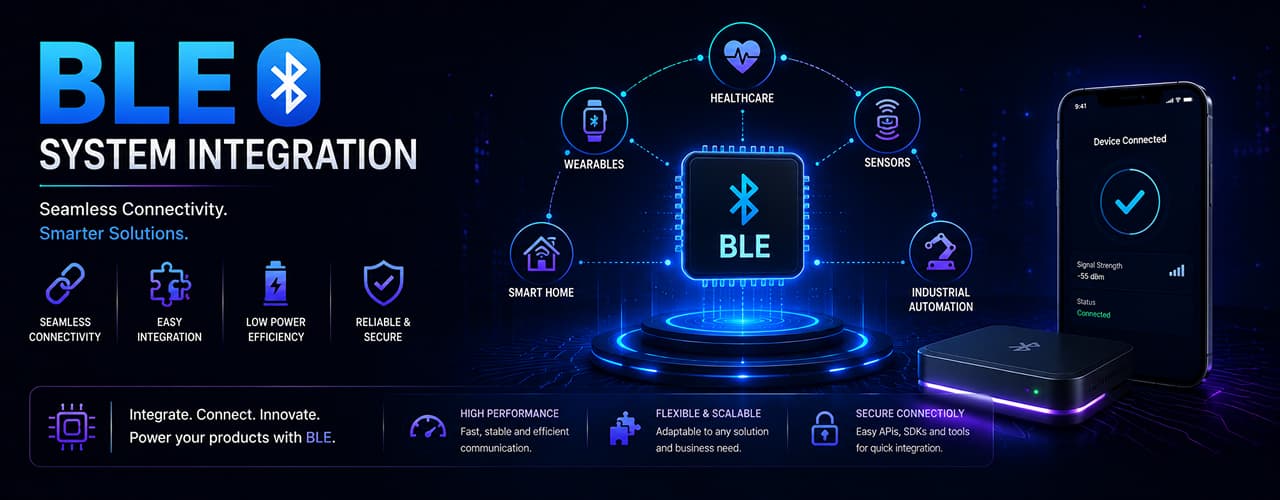
BLE System Integration: How to Integrate Smart Devices
Wireless communication has become one of the most important components of modern technologies. Fitness wearables, smart home solutions, and sensors are all examples of devices that require reliable communication. BLE System Integration helps to establish such communication and ensures low energy usage during this process.It has been extensively applied in IoT solutions due to its reliability, increased battery life and low costs. Whatever your IoT application may be – whether it is a health-care solution, an industry solution or consumer products – it will benefit greatly from the system integration.
What is BLE System Integration?
BLE System Integration is the process of linking hardware, software applications, and communication protocols through Bluetooth Low Energy technology. The purpose is to ensure proper interaction between all interconnected elements.
The solution can have different components such as sensors, gateways, cloud services, and mobile applications working together as a system. Business entities often resort to BLE integration for providing products that offer real-time information.
How BLE System Integration Works
BLE System Integration enables data sharing via wireless connection while consuming minimal power usage. The process usually involves the collection of data by the BLE -enabled device first. The collected data is sent via BLE connectivity to the destination device or gateway
Depending on the project, the data can be processed locally or sent to cloud platforms for monitoring and analytics. Besides, the BLE device integration helps to make sure that smart devices communicate properly among themselves
Benefits of BLE System Integration
In addition, many businesses spend money on BLE integration to ease the development process and provide flexibility in solutions.
Here are some reasons why businesses opt for BLE System Integration.
- Energy saving increases battery life.
- Wireless data transmission is more reliable.
- Scalability allows for growth of IoT ecosystems.
- Reduced time in development.
- Improved user experience from better device interaction.
Common Applications of BLE System Integration
Today, BLE System Integration is used across a wide range of connected products and services.
Developers often create a BLE system integration app that helps the users to manage the connected devices using smartphones easily.
Some common applications include:
- Smart home automation
- Wearable fitness devices
- Asset tracking solutions
- Smart retail systems
- Patient monitoring devices
- Environmental sensors
- Industrial automation
Industries that use BLE System Integration
The demand increases in different sectors due to its efficiency and versatility.
In industrial environments, BLE gateway system integration enables connection of several devices to central systems for better data management.
Some of the leading industries include:
- Healthcare
- Manufacturing
- Logistics
- Retail
- Smart Cities
- Agriculture
- Automotive
- Consumer Electronics
Challenges in BLE Integration and How to Overcome Them
While BLE System Integration has several benefits, businesses might face certain difficulties during this process.
Proper planning during the integration of BLE devices helps reduce these issues. Compatibility of the hardware, applying security measures, and conducting testing will make the system work better.
Common challenges include:
- Device compatibility
- Signal interference
- Security concerns
- Scalability requirements
- Firmware updates
- Data synchronization
Best Practices for Successful BLE System Integration
A successful BLE System Integration project depends on careful planning and the right development approach.
Businesses can further improve user experiences by implementing BLE mobile app integration, which will help users access device information, get notifications, and control connected systems through mobile apps.
Some recommended best practices include:
- Clearly define project requirements.
- Choose certified BLE hardware.
- Design scalable system architecture.
- Prioritize secure communication.
- Test devices under real-world conditions.
- Monitor system performance after deployment.
- Keep firmware and software updated.
FAQs
1. What is BLE and how does it work?
BLE (Bluetooth Low Energy) is a wireless technology used for transmitting data from one device to another without much power consumption.
2. Can phones connect to BLE?
Yes. Most modern Android or iOS smartphones have BLE capabilities to connect with the device.
3. How to activate BLE?
Turn on Bluetooth in your phone or device settings. It will work automatically with apps and devices.
4. How is BLE different from Bluetooth?
BLE consumes a lot less energy than Classic Bluetooth and is meant for small data exchanges, making it perfect for IoT devices.
5. Does BLE require the Internet?
No. BLE does not need an internet connection as it communicates directly among nearby devices. An Internet connection is required if data is sent to the cloud.
