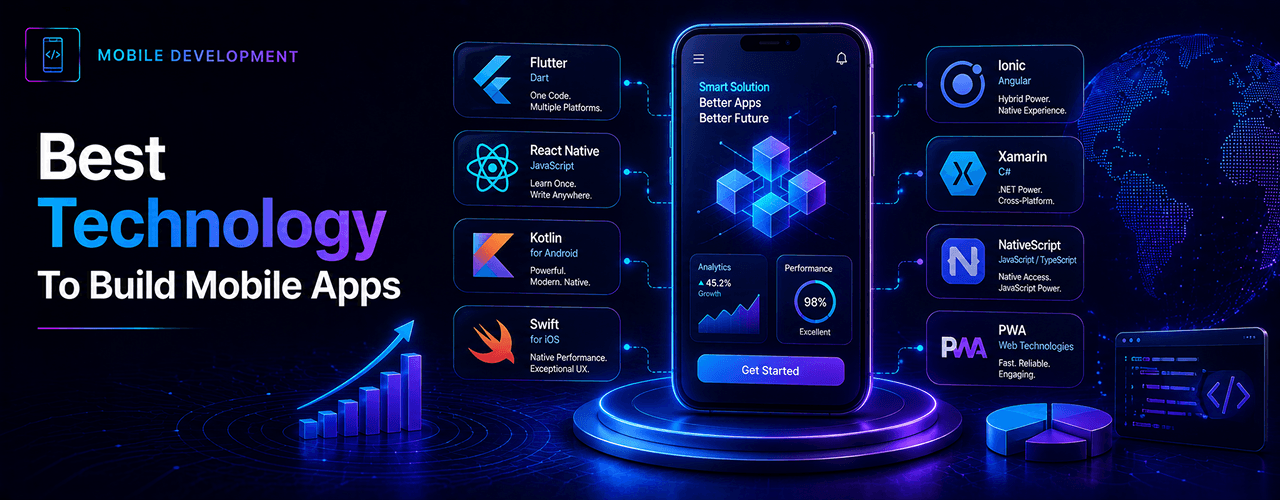
Best Technology To Build Mobile Apps
Inarguably, Mobile Apps have revolutionized the way people, think, communicate shop, eat, and drive today. Most of the e-commerce, fintech, tourism, automobile, and such other companies have added immense convenience in their business spectrum by making the best use of Android and iOS applications.
Since mobile devices are becoming a necessity with time, so is the application running inside them. Being miles away and yet being able to showcase your offerings to the end-users with the greatest ease is what builds brand loyalty. Wondering, where lies the magic? Is it in the tech stack used for developing a mobile application? Certainly yes, it’s indeed the tech stack mentioned below based on which mobile applications for your business are built.
List Of Best Technology To Build Mobile Apps
Angular Js
It is a JavaScript-based open-source tool that is used for building mobile and web applications. This front-end web framework is most suited for developing single-page applications. Its vast set of libraries serves makes it highly extensible and also allows working with other libraries collaboratively. The framework facilitates modification and replacement of the features to suit the unique development requirements.
React Native
This open-source UI framework was developed by Meta Platforms for developing applications for Android, iOS, Android TV, macOS, web, windows, tvos, and UWP along with native framework capabilities. Fondly, known as RN this is also a JavaScript-based mobile app development platform. Being an open-source framework, React Native is famous for its virtual DOM feature and gives the complete essence of native applications.
Furthermore, React Native helps to bring a declarative UI environment to both iOS and Android. Its effective UI control system provides full access to the native platform. As a result, makes the code predictable, easier to bug, and facilitates reloading without recoding.
Flutter
It is a UI toolkit by Google which is popularly used for building native applications for the desktop, web, and mobile. Being comprised of fully customized widgets, the Flutter toolkit supports the creation of native applications in the shortest duration. Moreover, its layered architecture allows faster rendering of components which boosts the overall performance of the mobile application.
This open-source and free framework uses existing code along with rich motion APIs, built-in Cupertino widgets, and material design for creating interactive iOS and Android applications.
Framework 7
It is also an open-source free platform known for its indispensable prototyping tool and gives the complete native look and feel. Yes, Framework 7 provides a set of stunning features which not only help to create Android and iOS applications but also the Progressive Web Applications (PWA) which is becoming the favorite choice of business entities in recent times.
Alongside, the pairing of extra tools like Electron and NW.js with Framework 7 helps to build native desktop applications. This framework comes with a vanilla JavaScript library and several other components of veu.js, react, and svelte.
Measurement Tools
Besides collecting the analyzes from quantitative and qualitative tools, few more measurement tools like A/B testing tools, conversion-tracking analytics, and the combination of the website heat map and session recording tools are used in the process.
How to move ahead with CRO?
There is no fixed this or that to execute successful conversion rate optimization. Thus, start by focusing on the basic elements which serve as the core of the CRO process.
- Keep a closer watch on what users say and do.
- Get immersed deeply in the market.
- Stay in touch with the website developers to communicate the website performance.
- Do not forget to establish a connection between diversified sources of feedback.
