AWS Application Modernization
AWS Application Modernization: Modernizing Legacy Applications
Modern businesses cannot afford to let aging applications slow down innovation. AWS application modernization provides a flexible foundation for transforming legacy systems into secure, scalable, cloud-ready platforms. The key steps for a successful modernization include architecture, business needs, security, automation, and measurable results.
What is AWS Application Modernization?
AWS application modernization is about upgrading your old applications via migration to cloud-native designs, managed services, containers, APIs, serverless, and other modern approaches. The goal isn’t to migrate an application to the cloud but to make it more scalable, safer, and easier to maintain and enhance.
In simple terms, businesses analyze their current application, discover technical and business limitations, and select the best path for modernization based on value. It becomes more focused and less disruptive as a result.
Why is AWS Application Modernization Important for Businesses?
Legacy systems can prove costly to support, hard to integrate, and less responsive to the changing needs of customers. AWS application modernization in creating a solid technical footing without necessarily having to change everything right away.
A modern architecture can support elastic capacity, automated deployments, better observability, and easier integration with new digital services. It can help in releasing features faster and reduce the reliance on old technologies.
How does AWS Application Modernization Work?
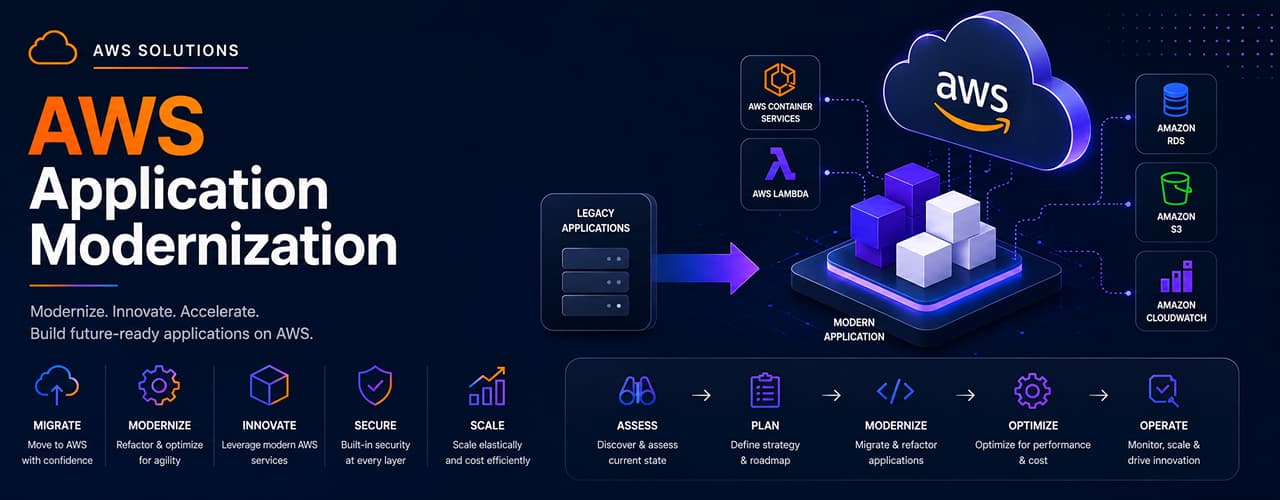
A successful modernization program usually begins with discovery. The team examines application architecture, dependencies, databases, integration, security needs, performance, and business needs.
Then, the team determines the target architecture and migration or modernization strategy. Finally, applications are refactored, migrated, tested, deployed, and monitored.
It will be helpful in modernizing legacy applications on AWS without disturbing business operations.
A practical workflow is:
- Evaluate the application and its dependencies.
- Identify modernization options and risks.
- Determine AWS services to use.
- Modernize the code, infrastructure, data, or integration.
- Performance, security, and reliability testing.
- Gradual deployment.
What are the Main AWS Application Modernization Strategies?
An effective strategy depends on application complexity, business value, technical debt, budget, and long-term goals.
The right choice is rarely the same for every workload. Portfolio assessment can prioritize applications by risk, value, complexity, and readiness.
Common approaches include:
- Rehost: Move an application to AWS with minimal changes.
- Replatform: Make targeted improvements while keeping the core application largely intact.
- Replatform: Make targeted improvements while keeping the core application largely intact.
- Rebuild: Create a new application around modern requirements.
- Replace: Adopt a suitable commercial or managed solution instead of maintaining the legacy system.
Which AWS Services are Used for Application Modernization?
AWS offers a broad ecosystem for application transformation. Compute services such as Amazon EC2, Amazon ECS, Amazon EKS, and AWS Lambda can support different modernization architectures. Amazon RDS and Amazon DynamoDB can support modern data requirements, while Amazon S3 provides scalable object storage.
The AWS tools provide automation for assessment, deployment, monitoring, and management of infrastructure. The combination of services should be done depending on workload needs.
Businesses searching for aws application modernization services can benefit from the service-oriented strategy that links cloud migration and application engineering.
How can AI Improve AWS Application Modernization?
AI-powered application modernization can accelerate several parts of the transformation lifecycle. AI can assist in analyzing code, finding dependencies, documenting the legacy logic, suggesting changes in code, creating tests, and helping with refactoring efforts.
It can improve decision-making by helping teams identify modernization candidates and prioritize technical work.However, AI must assist engineers in making decisions, not replace them. A human check is essential in architecture, security, data management, regulatory issues, and readiness for production.
For this reason, AI works best when integrated into a controlled modernization process with clear governance and measurable quality checks.
What are the Benefits of Modernizing Legacy Applications on AWS?
The benefits extend beyond infrastructure migration. A well-planned modernization can improve scalability, application performance, deployment speed, security, resilience, and operational visibility.
It can also reduce technical debt and make it easier to introduce APIs, automation, analytics, and AI capabilities. These improvements create a technology foundation that adapts to new products, customers, and workloads.
Following AWS modernization best practices—such as incremental delivery, automated testing, strong identity controls, monitoring, cost management, and continuous improvement—helps businesses turn modernization into a sustainable operating model.
Why choose Centrelocus?
Centrelocus combines cloud, AI, data, and modern software development expertise to help organizations build scalable digital products and transform existing technology. Our digital transformation practice includes cloud migration and DevOps, enterprise software modernization, legacy system integration, and IT consulting.
For organizations evaluating aws application modernization, Centrelocus can bring discovery, architecture, development, testing, deployment, and ongoing support into a structured delivery process.
FAQs
1. What are the pillars of AWS?
AWS Well-Architected currently has six pillars: operational excellence, security, reliability, performance efficiency, cost optimization, and sustainability.
2. What is application modernization on AWS?
Modernization refers to the practice of converting old applications with the help of AWS cloud services.
3. How does AWS help with application modernization?
AWS offers databases, containers, serverless technologies, migration tools, monitoring, and automation services for modernization.
4. What are the benefits of modernizing applications on AWS?
Benefits include scalability, performance, security, resiliency, fast deployment, efficiency, and integration with new technology.
5. Can AI be used in AWS application modernization?
Yes. AI can be used to analyze, discover dependencies, transform, test, document, and modernize, under human engineering control.
