
Automotive Software Development
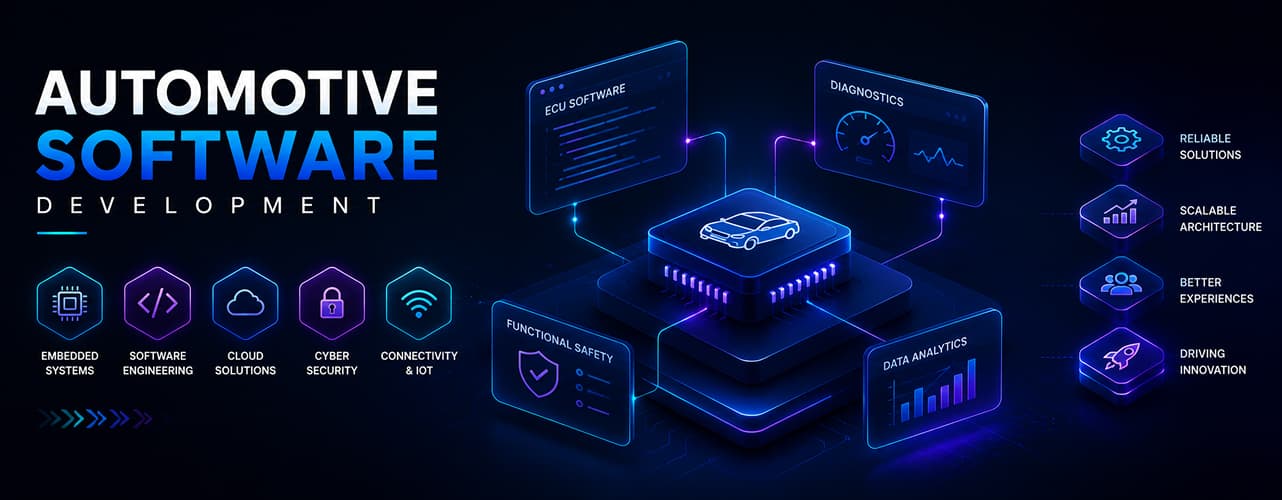
Automotive Software Development for Intelligent Mobility
The automotive industry is witnessing one of the greatest changes in technology that it has seen in its history. Vehicles have evolved to become software-enabled, intelligent, and connected systems rather than just being modes of transport. Applications ranging from ADAS to infotainment, predictive maintenance, and fleet management systems rely on software technologies.By engaging in automotive software development, businesses can benefit from improved vehicle performance, enhanced user experience, and increased operational efficiency.
What is Automotive Software Development?
Understanding what is automotive software development, is the initial phase for embracing digital transformation in mobility. This means creating software applications for automobiles and associated manufacturing facilities and processes.
Modern automotive software allows seamless interaction among vehicles, cloud platforms, sensors, mobile apps, and other enterprise-level information systems. These include diagnostic tools, navigation systems, updates, and other intelligent automation features.
Why the Automotive Industry Depends on Software
Modern-day automobiles produce massive amounts of data via sensors, cameras, GPS units, and onboard computers. Conversion of such data to meaningful information calls for sophisticated software tools capable of handling real-time processing and secure
This is how transportation will be revolutionized for automotive companies, suppliers, fleets, and mobility providers.
Key business benefits include:
- Vehicle safety improvement
- Maintenance prediction
- Connected vehicle solutions
- Manufacturing process improvement
- Remote diagnostics
- Fleet management
- AI-based decision-making
- Customer engagement
Automotive Software Solutions for Modern Businesses
Specialized automotive software development services are needed for an organization in accordance with its business needs to make sure they scale well.
Automotive software development services will help companies to provide smooth digital experience and grow.
Common solutions include:
- Connected car platform
- Fleet management software
- Automotive diagnostics software
- Automotive infotainment application
- Autonomous driving systems software
- Automotive dealer management software
- Automotive tracking software
- Predictive maintenance software
- EV charging management software
- MaaS platform
Essential Features of Modern Automotive Software
Successful software platforms incorporate performance, security, scalability, and user-centric design.
Core features include:
- Cloud connectivity
- Internet of things connectivity
- Real-time analysis
- Mobile application development
- API security
- GPS tracking
- OTA software updates
- Compatibility with multiple devices
- Predictive analysis
- Performance dashboards
Technologies Powering Automotive Software
Modern software development for automotive involves the use of various technologies that help in building extremely efficient digital ecosystems.
Use of these technologies enables companies to build secure and scalable mobility platforms.
Some of the most important technologies include:
- Artificial Intelligence
- Machine Learning
- Internet of Things (IoT)
- Edge Computing
- Cloud Computing
- Kubernetes
- Docker
- Blockchain
- Big Data Analytics
- Digital Twins
- 5G Connectivity
Development Process
Effective software development for automotive approaches with reduced risks is necessary while ensuring quality and compliance.
A proven development lifecycle typically includes:
- Analysis of business requirements
- Architecture of solution
- UI/UX design
- Agile software development
- API integration
- Deployment in cloud
- Security testing
- Performance tuning
- Monitoring
- Maintenance
Security and Compliance
Security is very important due to the fact that cars share their operational and customer data.
Strong cybersecurity practices help to reduce risks while maintaining customer trust.
Modern automotive platforms should include:
- Encryption throughout the system
- Authentication
- Access control based on roles
- API security
- Data privacy compliance
- Vulnerability assessment
- OTA update mechanisms
Future Trends in Automotive Technology
Organizations that invest in these innovations now will be well-prepared to satisfy their customers' expectations in the future.
Future developments in the field of mobility will include:
- Software Defined Vehicles (SDVs)
- Connected transport ecosystems
- Self-driving vehicles
- Electric vehicle platforms
- AI-based predictive analytics
- Vehicle to Everything (V2X) communications
- Digital twins
- Smart manufacturing
- Sustainable mobility solutions
