Application Modernization Services
Application Modernization Services for Scalable Digital Transformation
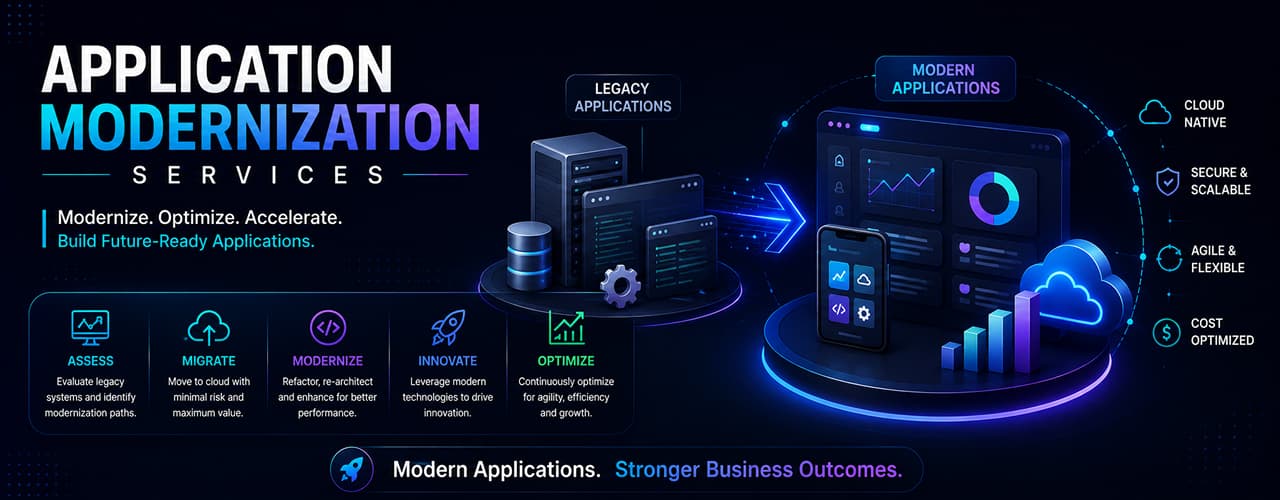
Application modernization helps businesses to update older software applications, increase their efficiency, and ready them for future requirements of the business. Rather than replacing every system at once, organizations can modernize selected applications, improve architecture, connect them with modern platforms, and introduce cloud and AI capabilities. Application modernization services become the solution for businesses that plan to transition from legacy to scalable digital solutions.
What are Application Modernization Services?
The application modernization meaning is simple. It is the process of updating existing applications to make them compatible with current technology trends, business needs, and user requirements. Application modernization services may include analysis of old software, improving code quality, rearchitecting, workload migration, integration with API, and enhancing performance.
Modernization does not always mean rebuilding an application from scratch. Depending on its condition, a company may choose to do a selective refactoring of its application, platform change, functional replacement, or service introduction into an existing application.
Why do Businesses Need Application Modernization?
Older applications can become hard to maintain. They would depend on old frameworks, poor infrastructure, disparate systems, or manual procedures. Business needs evolve over time, and those limitations would have an impact on speed, scalability, security, and introduction of new features.
A company might require a software upgrade if it needs its programs to fit in well with the cloud, analytics, API and AI capabilities. A good strategy will allow organizations to benefit from what they have already invested in their software.
Application modernization services examples include moving an on-premises application to the cloud, segmentation of a monolithic architecture, renovation of a legacy UI, or integration of a legacy application with modern APIs.
What do Application Modernization Services include?
Application modernization services can include several focused activities based on the application's needs. Common areas include:
- Legacy application assessment to understand technical debt, dependencies, risks, and business priorities.
- Application refactoring to improve code structure and maintainability without changing the core purpose.
- Replatforming to move applications to modern infrastructure with fewer architectural changes.
- API integration to connect older applications with newer software, services, and data sources.
- Cloud modernization to improve scalability, availability, and flexibility.
- Testing, deployment, and optimization to help ensure a stable transition.
- Application redesign or redevelopment when an existing system no longer supports current business needs.
How does Application Modernization work?
This phased approach can reduce disruption and make modernization easier to manage.
A successful project starts with understanding the existing application. The process typically follows these steps:
- Discovery and assessment: Review the application, technology stack, dependencies, and business requirements.
- Modernization planning: Define priorities, target architecture, timeline, and suitable approach.
- Design and development: Improve or rebuild selected components while preserving essential functionality.
- Integration and testing: Connect the modernized application with required systems and validate performance, security, and usability.
- Deployment and support: Release the solution in a controlled manner and continue monitoring and optimization.
What are the Benefits of Application Modernization?
Application modernization services can help to improve performance, increase scalability, simplify maintenance, enhance security, and offer greater flexibility. Modernized applications may facilitate integration of innovative technology and faster reaction to changes in customer needs.
Businesses can reduce technical limitations while creating a stronger foundation for future digital initiatives. Modern application architecture can ensure more effective processes of development and operations.
How can AI Improve Application Modernization?
AI is becoming an important part of modern software transformation. AI application modernization services are used to introduce intelligence into legacy systems, automate operations, and perform data analysis and experience optimization.
AI-powered application modernization can support intelligent search, conversational interfaces, recommendations, document processing, predictive insights, and workflow automation. The goal is to identify how intelligent applications can bring tangible business benefits.
The benefits of AI application modernization can include faster processes, improved decision support, greater automation, and more personalized digital experiences.
Why choose Centrelocus?
Centrelocus approaches digital transformation through AI, cloud, data, and modern software development. Our described process comprises discovery, design, development, and delivery, offering an effective way to understand requirements, design solutions, develop software, and provide support for software deployment.
Application modernization services can further be enhanced by our software development capabilities, which include scalable web applications, custom software, SaaS engineering, APIs, and mobile applications.
FAQs
1. What are application modernization services?
Application modernization services help businesses in upgrading legacy applications through modern technology, architecture, and infrastructure.
2. What does application modernization mean?
Application modernization means improving existing applications to improve security, scalability, efficiency, and compatibility of the application with modern technologies.
3. How to modernize an application?
Modernize an application by assessing the current application, select a proper method for modernizing it, upgrade its architecture or code, test it, and deploy it.
4. What are the benefits of application modernization?
The key benefits involve performance, scalability, security, maintainability, integration, and technical debt reduction.
5. Why is application modernization important for businesses?
It helps businesses overcome legacy technology constraints, minimize maintenance problems, increase efficiency, and facilitate future digital expansion.
6. Can AI be used for application modernization?
Yes. AI can assist in code analysis, automation, testing, intelligence, predictions, and improved application functions.
