API Integration
API Integration: Connect Systems, Automate Workflows, and Scale Smarter
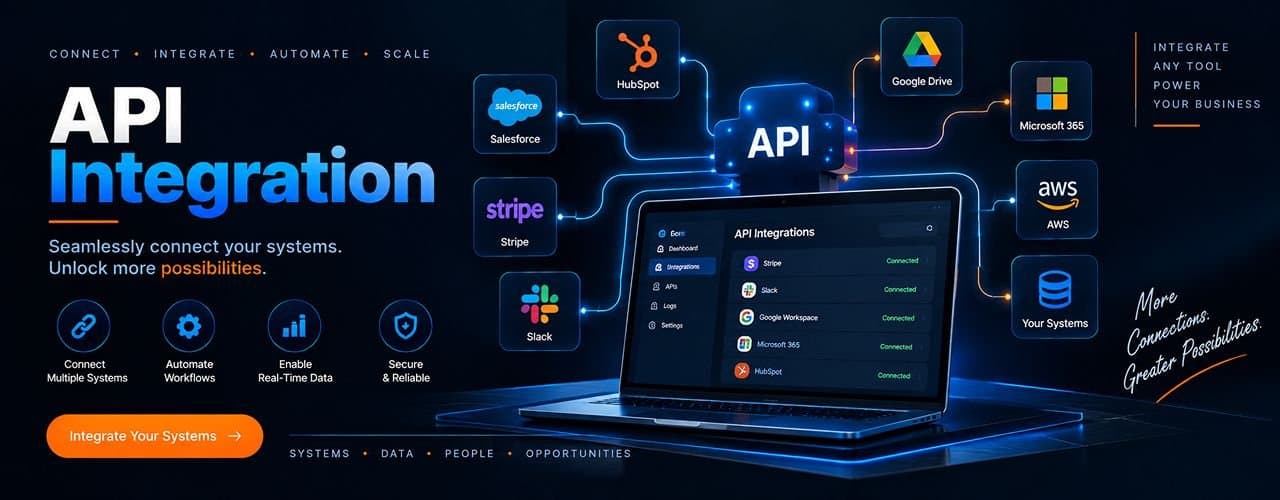
Modern businesses use multiple software systems, from CRM and payment platforms to cloud apps and enterprise tools. API Integration works to integrate these systems, allowing them to exchange data, execute commands, and automate processes seamlessly. When implemented properly, it reduces manual work, improves efficiency, and creates seamless digital experiences.
What is API Integration and How Does it Work?
API integration meaning the linking of two or more software programs in order to exchange data or functionality. The process establishes a communication link between systems which would normally run independently.
API integration full form is Application Programming Interface integration. An API gives instructions on how one application may make a request for data or functionality from another application.
The objective is to create a dependable connection that works securely and can be maintained as business needs change.
A typical integration process involves:
- Identifying the systems and business requirements.
- Reviewing API documentation, endpoints, authentication, and limitations.
- Configuring requests, responses, and data mapping.
- Testing the connection and handling possible errors.
- Monitoring the integration after deployment.
Why is API Integration Important for Modern Businesses?
Businesses adopt API integration to connect their technology environment, automate tasks, and optimize information exchange between different applications.
Its major benefits include:
- Automation: Reduces repetitive data entry and manual processes.
- Better data consistency: Keeps information synchronized between connected systems.
- Faster operations: Helps teams access information without repeatedly moving between platforms.
- Improved customer experiences: Supports features such as online payments, notifications, tracking, and personalized services.
- Scalability: Makes it easier to introduce additional applications and services as the business grows.
What are the Different Types of API Integration?
There are several API integration types, and the best one is determined based on the specific systems and business objectives that are involved.
The integration of API solutions must consider factors such as security, amount of data, compatibility of applications, business logic, and scalability.
Common approaches include:
- Point-to-point integration: Directly connects two applications and can work well for straightforward requirements.
- Third-party API integration: Connects an application with an external service such as payments, maps, communication, or analytics.
- Internal API integration: Connects applications or services within an organization's technology environment.
- Cloud API integration: Links cloud applications and services to create connected workflows.
- Middleware-based integration: Uses an intermediate layer to manage communication, data transformation, routing, or orchestration.
How Does API Integration Improve Business Processes and Efficiency?
Well-designed API integration can turn disconnected applications into a coordinated technology environment. Instead of having employees moving data manually between different platforms, the systems can communicate on their own.
Common business use cases include:
- Payment processing and transaction updates
- Customer and employee data synchronization
- Shipping and delivery tracking
- Reporting and analytics
- Automated notifications
- CRM and ERP connectivity
- Cloud application integration
What Challenges Should You Consider When Integrating APIs?
Successful API integration involves more than making two applications communicate. It is vital that security, compatibility, reliability, and maintenance be planned for in advance.
Using reliable API integration tools can assist with testing, monitoring, documentation, and workflow management. However, tools should support a sound technical strategy rather than replace proper planning.
Some common challenges include:
- Authentication and security: APIs may use API keys, tokens, OAuth, or other authentication methods. Sensitive information must be properly protected.
- Data compatibility: Different applications may use different formats, field names, or data structures.
- Rate limits: External APIs may restrict the number of requests an application can make within a specific period.
- Version changes: API providers can change endpoints or discontinue older versions.
- Error handling: Systems need appropriate responses when an API is unavailable or returns unexpected data.
- Monitoring: Integration performance should be monitored so failures can be identified and resolved quickly.
How to Choose the Right API Integration Approach for Your Business?
The right API integration approach depends on the business objective, existing technology, security requirements, and expected growth.
A reliable implementation should be properly tested before deployment and documented for future development and maintenance.
Before selecting an approach, consider:
- Business goal: What systems need to communicate, and what problem should the connection solve?
- Security: What information will be exchanged and what protection is required?
- Scalability: Can the approach support increasing users, requests, and applications?
- Compatibility: Do the APIs provide suitable endpoints, authentication methods, documentation, and data formats?
- Maintenance: Who will monitor, update, test, and troubleshoot the connection?
- Future requirements: Can new applications be added without creating unnecessary technical complexity?
Why Choose Centrelocus for API Integration Services?
Choosing the right technology partner can make API integration easier to implement, maintain, and scale. Centrelocus approaches integration by first understanding the business requirement and existing technology environment before determining the most suitable technical approach.
Our API integration services can help businesses connect applications, third-party platforms, cloud services, and internal systems while keeping security, scalability, and maintainability in focus.
For businesses looking to connect multiple applications without creating unnecessary technical complexity, a well-planned integration strategy can create a more connected and efficient digital environment.
Our approach can include:
- Understanding business and technical requirements
- Evaluating APIs and integration possibilities
- Designing secure data flows
- Developing and testing integrations
- Supporting monitoring and future improvements
Frequently Asked Questions
1. What is API integration?
API integration connects different software applications so they can exchange data or functionality automatically.
2. What is API full form?
API stands for Application Programming Interface. It defines how software applications communicate with each other.
3. What is the difference between API integration and API development?
API development creates an interface that exposes data or functionality. API integration connects existing APIs or systems so they can work together.
4. Is ChatGPT an API?
No. ChatGPT is an AI application and service. OpenAI also provides APIs that developers can use to integrate AI capabilities into their own applications.
5. Why is API integration important for businesses?
It connects business systems, reduces manual work, improves data flow, and supports automated workflows.
6. What are the different types of APIs?
Common API types and styles include REST, SOAP, GraphQL, and WebSocket APIs. The right option depends on the application's communication requirements.
