AI in Insurance Industry
AI in Insurance Industry: AI Transforming Modern Insurance
The insurance sector has always relied on data, risk assessment, and customer trust. Thanks to fast development of artificial intelligence, insurers can make improvements in these areas, as well as offer better services quickly and in a personalized way. It should be mentioned that AI in insurance industry is not anymore a new idea; it is already a solution.In this article, we'll explore how AI is changing insurance, its major applications, benefits, challenges, and what the future holds.
What Is AI in Insurance?
Many people ask, what does ai mean in insurance? It means using artificial intelligence methods like machine learning, natural language processing, predictive analytics, and computer vision to automate and enhance the insurance operations.
While the manual approach was used in the past to deal with all these tasks, today, insurers apply the AI technology to examine large amounts of data, detect patterns, make predictions and facilitate smarter decision-making.
AI in insurance industry helps companies to automate all the processes from customer onboarding to claims handling.
Why the Insurance Industry Is Investing in AI
Insurance companies deal with thousands and millions of records, policies, and claims annually. It is very difficult to deal with this process manually.
The growing adoption of Artificial Intelligence in Insurance is helping companies address these problems by automating routine tasks and gaining new business insights through analysis of the existing data. Modern AI platforms are able to analyze past records, recognize anomalies, and help underwriters make better decisions.
As customer expectations continue to evolve, the AI in insurance industry enables insurers to provide quick reaction and customized policies, which makes their clients happy.
How Is AI Used Across Insurance Operations?
One of the most common questions businesses ask is how is AI used in insurance. The answer lies in its capacity to enhance almost all stages of the insurance process.
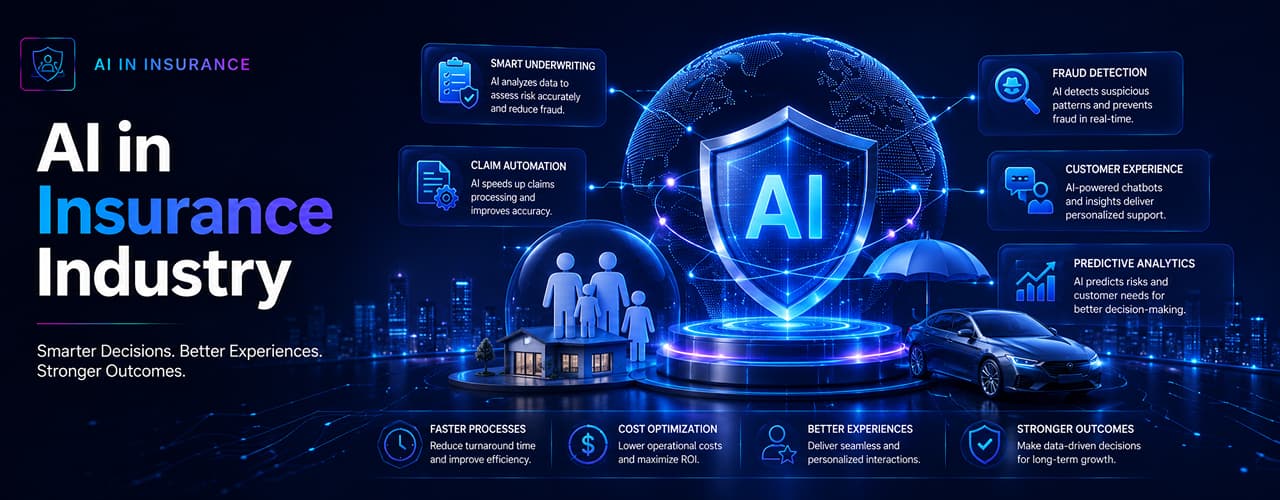
1. Smarter Underwriting
AI analyses customer information, financial records, driving behaviour, medical history, and other relevant data to assess risk more accurately. This helps insurers create fair pricing models while reducing manual effort.
2. Faster Claims Processing
One of the biggest advantages of AI in insurance claims is automation. AI can analyze submitted documents, confirm policy details, spot missing information, and even calculate the extent of damages via computer vision technology.
Instead of waiting days or weeks, customers can receive claim decisions much faster.
3. Fraud Detection
Insurance fraud costs companies billions every year. AI systems identify suspicious claim patterns, compare historical data, and flag potentially fraudulent activities for further investigation.
4. Customer Service Automation
AI-powered virtual assistants and chatbots answer customer questions 24/7, helping policyholders receive instant support without waiting for a representative.
These improvements demonstrate how AI in insurance industry is making insurance operations faster, smarter, and more customer-centric.
The Rise of Generative AI in Insurance
Unlike traditional AI, generative AI can create content, summarise policy documents, draft customer emails, generate reports, and assist support teams with accurate responses.
As businesses continue investing in generative AI in insurance, insurers are learning more ways to be productive while minimizing their workload.
Some practical applications include:
- Producing customized insurance suggestions
- Summarizing policy documents
- Helping customer service agents
- Knowledge management automation
- Documenting internally
Benefits of AI for Insurance Companies
AI in insurance industry offers numerous business advantages beyond automation.
Improved Accuracy
AI analyses significantly larger datasets than humans, leading to more precise underwriting and risk assessments.
Better Customer Experience
Customers receive quicker policy approvals, faster claims settlements, and personalised recommendations based on their unique needs.
Lower Operational Costs
Automation reduces repetitive manual tasks, allowing employees to focus on higher-value activities.
Enhanced Risk Management
AI continuously monitors data to predict risks before they become costly problems.
Scalable Operations
As insurers grow, AI systems can manage increasing workloads without requiring proportional increases in staffing.
These advantages explain why many organisations are investing heavily in AI-powered insurance solutions to remain competitive.
The Future of AI in Insurance
The future of AI in insurance industry looks increasingly promising. As technologies continue evolving, insurers will rely more heavily on predictive analytics, intelligent automation, and personalised customer experiences.
Businesses that invest in AI today will be better prepared to adapt to changing customer expectations and market demands.
The continued evolution of Artificial Intelligence in Insurance will not only improve operational efficiency but also strengthen trust between insurers and policyholders.
We can expect future innovations such as:
- Real-time risk monitoring
- Hyper-personalised insurance policies
- Voice-enabled insurance assistants
- Autonomous claims processing
- AI-driven regulatory compliance
FAQs
1. What does AI mean in insurance?
It refers to the use of AI technologies including machine learning, predictive analytics, and automation for the improvement of underwriting, claims management, fraud detection, customer support, and process efficiencies.
2. How is AI used in insurance?
These are automated claims management, customer risk assessment, fraud detection, customer support through virtual agents, personalized insurance policies, and improved underwriting accuracy.
3. What are the benefits of AI in the insurance industry?
Some of the advantages include fast claims processing, accurate risk assessment, reduction in operational costs, customer satisfaction, fraud detection, and accurate decision-making.
4. What is generative AI in insurance?
Generative AI in insurance uses advanced AI models to create policy statements, communications, documentation, recommendations, and knowledge base material, thus helping insurance firms enhance their productivity.
