
2D vs 3D Games
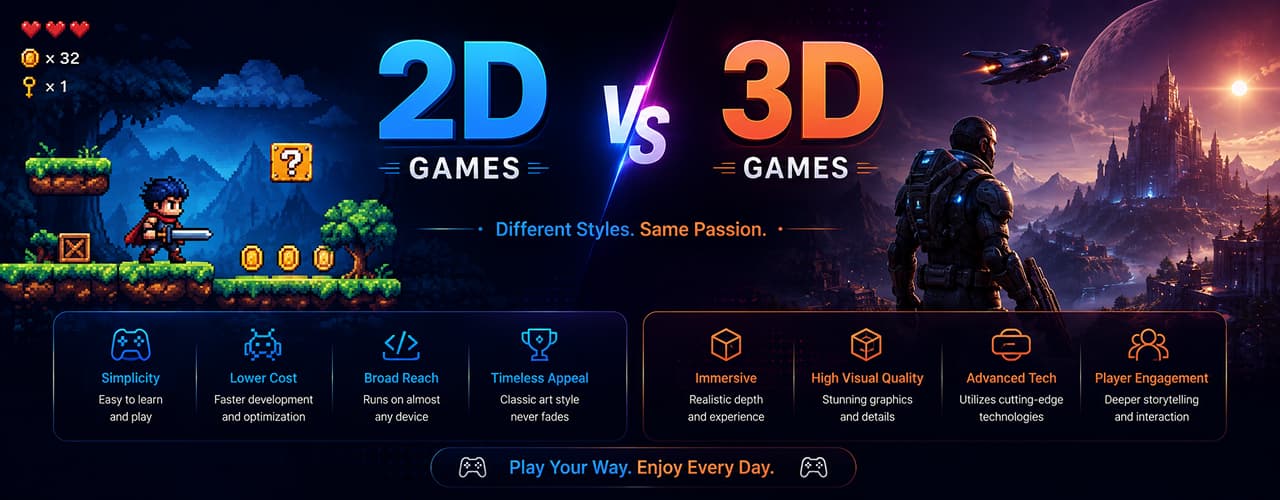
2D vs 3D Games: Which One is Better?
2D vs 3D games differ mainly in graphics, gameplay, development complexity, and player experience. Although 2D games have flat graphics and simple design, 3D games offer players an immersion into a real-life environment.
What are 2D Games?
2D games use a flat visual space where characters, objects, and environments are mainly represented across height and width. Platformers, puzzle games, card games, and many mobile titles use this approach.
A major strength of 2D games is their simplicity in visual depiction. The players are easily able to comprehend the environment and the controls that are involved. For a developer, 2D game development could be a viable option.
What are 3D Games?
3D games make use of spatial depth to allow players to navigate through spaces from various angles. The most common types of 3D games include racing, action, simulation, role-playing, and open-world games. Things can be designed, animated, lit up and observed from different angles.
3D games offer an immersive gaming environment since one interacts with a virtual world that resembles reality. This gaming paradigm can offer an elaborate world and flexible movement.
2D vs 3D Games: Key Differences
The choice between 2D vs 3D games depends on the concept of the game, its audience, gaming platform, resources available and the experience the developer wants the player to enjoy.
Graphics and Visual Experience
2D games rely on sprites, illustrations, layers, and animation to create their visual identity. Their art style can work particularly well for mobile, indie, educational, and casual games.
3D games use models, textures, lighting, cameras, and space in order to make their world more interesting and realistic. The difference between 2D and 3D games is especially noticeable especially if the game requires exploration and realistic environments.
Gameplay and Mechanics
2D gameplay often uses clear movement paths, fixed perspectives, or side-scrolling mechanics. This could result in simpler controls and allow for greater focus on designing levels, timing, puzzle solving and progress.
3D gameplay offers more freedom of movement and camera control. Players may walk, drive, fly, explore, or interact with objects from different directions. In terms of 2D games vs 3D games, the choice will be determined by whether gameplay needs to involve depth and spatial interaction or not.
Development Time and Cost
Development scope can change significantly between projects. A simple 2D title may require fewer visual assets, simpler environments, and less complex animation. A larger 3D project may need detailed models, rigging, physics, lighting, environment design, and testing.
Performance and Device Requirements
2D games generally have fewer demanding visual calculations, making them easier to optimize for lower-powered devices.
3D games can require more processing power because they may use complex models, lighting, physics, and real-time rendering. Still, well-done optimization will ensure smooth gameplay on most devices. A thoughtful 2D vs 3D game performance strategy should consider resolution, asset size, rendering load, memory use, and target hardware.
Advantages of 2D Games
Main Advantages of 2D games include:
- Simpler visual pipelines
- Accessible gameplay
- Faster prototyping
- Flexible art styles
- Flexibility in the process of developing the game
- Lower development costs
Advantages of 3D Games
Main Advantages of 3D games include:
- Immersive environments
- Dynamic camera angles
- Elaborate storytelling
- Realistic visuals
- Ideal for genre games which involve open world interactions
2D vs 3D Games: Which one is Better?
There is no universal winner in 2D vs 3D games. One more criterion by which it is possible to assess the project is its scale and players' experience.
It would be most effective for teams considering the option between 2D and 3D game development services to start with the players' experience rather than the technical aspects of the project. Then select the production approach that supports those requirements.
In practical terms, 2D vs 3D games should be treated as a project-specific decision. While 2D games can be effective and streamlined, 3D games offer more immersion and freedom. Both can result in great games in the end.
Conclusion
In the end, 2D vs 3D becomes a matter of technology fitting the desired experience. Deciding on 2D vs 3D games depends on several other factors besides how appealing you think your game should look.
For businesses planning a new game, experienced technical guidance can help turn an initial concept into a practical development roadmap. Centrelocus assists businesses with 2D vs 3D game development and technology-oriented solutions based on project needs.
FAQs
1. What is the difference between 2D and 3D games?
2D games make use of flat graphics whereas 3D games make use of graphics that are three-dimensional.
2. Are 2D games better than 3D games?
No, not necessarily. While 2D is suitable for straightforward gameplay, 3D is the appropriate option for exploring and realistic gameplay.
3. Are 2D games easier to develop?
In most cases, yes. 2D games normally have simpler requirements compared to 3D games.
4. Are 3D games more expensive to develop?
Generally, yes. 3D games can take more resources to model, animate, light, apply physics, develop, and optimize.
5. Which is better for mobile games, 2D or 3D?
It depends on your needs. 2D is good for simple mobile games, while optimized 3D is better for immersive ones.
